
CYANCA | Podcast Interview
Special | 44m 2sVideo has Closed Captions
CYANCA’s journey of healing, heritage and self‑discovery fuels her bold, genre‑bending sound.
CYANCA opens up about growing up in rural NC, her church roots and crafting a sound shaped by resilience and healing. From honoring her late mother’s legacy and overcoming hearing loss to meeting her hero Erykah Badu, she shares how identity and reinvention define her artistry and voice. Hosted by PBS NC’s James Mieczkowski.
Problems playing video? | Closed Captioning Feedback
Problems playing video? | Closed Captioning Feedback
Shaped by Sound is a local public television program presented by PBS NC
Made possible through support from Come Hear NC, a program of the N.C. Arts Council within the N.C. Department of Natural and Cultural Resources.
CYANCA | Podcast Interview
Special | 44m 2sVideo has Closed Captions
CYANCA opens up about growing up in rural NC, her church roots and crafting a sound shaped by resilience and healing. From honoring her late mother’s legacy and overcoming hearing loss to meeting her hero Erykah Badu, she shares how identity and reinvention define her artistry and voice. Hosted by PBS NC’s James Mieczkowski.
Problems playing video? | Closed Captioning Feedback
How to Watch Shaped by Sound
Shaped by Sound is available to stream on pbs.org and the free PBS App, available on iPhone, Apple TV, Android TV, Android smartphones, Amazon Fire TV, Amazon Fire Tablet, Roku, Samsung Smart TV, and Vizio.
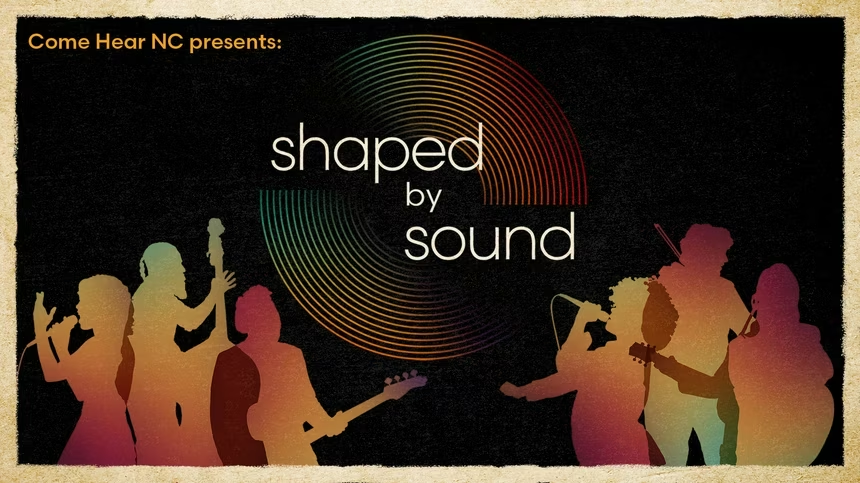
Explore Shaped by Sound
Dive deeper into Shaped by Sound. Explore the standout artists from Seasons 1 and 2, meet the show and podcast host, James Mieczkowski, and discover more ways to watch and listen.Providing Support for PBS.org
Learn Moreabout PBS online sponsorshipThe Shaped by Sound podcast is made possible through support from Come Hear NC, a program of the North Carolina Arts Council within the North Carolina Department of Natural and Cultural Resources.
CYANCA, thank you so much for being on the show.
Thanks for being on Shaped by Sound.
And we're really excited to have you here.
Thank you.
I'm glad to be here.
Awesome.
So let's start with, you grew up in Smithfield.
I did.
Right.
And can you kind of tell us a little bit about Smithfield?
Hmm.
Smithfield was very, a lot of country living, four wheelers, deer hunting, a lot of pork eating.
Yeah, that's really what my life and a lot of church.
That was my upbringing in Smithfield.
I mean, I graduated with like 79 other kids from high school.
So real small town community, but yeah, that's just the basis of Smithfield.
Yeah.
So as a little kid, you were just like ripping around on a four wheeler and... Absolutely.
I mean, playing hide and go seek, BB guns, shooting cans, you know, all the fun stuff you should do as a country kid.
Yeah.
So there must have been a lot of freedom out there then.
You kind of just explore and just figure out what you wanted to do.
Right.
That's incredible.
I would like to know a little bit more about that freedom, right?
And like, how did that sort of leak into you getting into music?
I think it was really, um, because I grew up in a church and I was in the church a lot.
So as a kid, it's very hard to keep your attention span.
So in church, I just gradually start to navigate towards the instruments.
So I'm sitting in church and I'm just like, okay, he's preaching, which I was grateful for, but it was like times I'm like, hmm, let me look over what my cousin on the organ is doing.
So I'm finding myself drifting up there after church, kind of like curiosity.
I want to like touch on the keys or I want to play the drums and I will always get in trouble for it.
Yeah.
Like, you know, because it wasn't the norm for a woman to play instruments, especially in a Baptist church.
Hmm.
Cause we were wearing skirts.
So I didn't, I wasn't allowed to wear pants.
So it didn't make sense, you know, me up there.
But my grandmother, she saw that I really had a strong knack for it.
So about like six or seven, um, for Christmas, I kept telling my grandparents, I want a drum set, I want a drum set.
And my dad, he bought me one for Christmas.
It was all white, gold trimming, and I played it every day.
And that's what really, it really started in church.
Like my love for music.
Was there a moment there, so you said like people didn't, it was sort of frowned upon that you were doing that.
Right.
And it felt like you had to really make a step to do that.
So you had a lot of courage as a kid then to kind of, to really break through and like go after that.
Yeah.
Because my family always knew that I could sing.
So they preferred me to sing over playing instruments and I did not want to sing.
I wanted to go play instruments.
I didn't like being in the spotlight.
So I had to navigate that for a while and I kind of just dealt with it for years.
And then when I got to like high school, that's when I got more freedom.
Now I'm in the marching band.
I don't have to like succumb to religious, you know, taxes and everything that they did at church.
So yeah, that's where it kind of really grew is when I got to high school, I got a lot more freedom.
And then I went to college for music.
I studied music percussion at UNC Greensboro.
Yeah.
So I'm also a fellow UNC Greensboro grad, I guess.
So go Spartans.
But that's so interesting.
So, I mean, you get into the marching band, what were you playing?
Drums.
I was playing the snare.
I was a drum captain.
So I played quads.
I played every instrument.
You had to play every instrument in order to be drum captain.
So by my senior year, I was drum captain.
I was the captain of the basketball team.
I had a lot of strong roles when I was in high school.
Yeah.
So you're the captain of multiple things.
Do you feel like that's sort of like, it almost seems like you, is that sort of your personality in a way where you like to just grab something and go for it and maybe lead?
I'm going to say this.
I was in a very predominantly white environment.
So I graduated with like two other black people in my high school.
So it was very important for me to make a statement.
Like I was senior class president, a black woman.
They didn't like that.
But I loved it.
I was like, I got to make a statement.
And I also had, I had amazing best friends that were, you know, white and Hispanic and they supported me.
But yeah, I think when I got to high school, it was really like, I'm going to make a statement.
There also must come with that, like a lot of pressure.
Oh, absolutely.
Yeah, for sure.
How did you like get through that?
It was just in me.
Innately, you know, my grandmother was heavily in the church.
She was a leader.
She was the head of the mother board.
She was the head of the missionary department.
The missionary department was in charge of going out to people who were sick in the church and cooking for them, washing their clothes.
So I would travel with her to do those things.
And I would see how she was a leader in the church.
So that kind of, yeah, it passed down to me.
Yeah.
So she was a big influence for you then.
Absolutely.
Yeah.
Outside of high school and college where you're going to school for music, you've also said that you were, you had sort of a difficult time at college, like with music.
Can you explain that a little bit?
I think I had a difficult time because I had grew up playing and learn to sing by ear.
But now, and I mean, I learned music theory in high school, but it was super intense in college.
Like now we're having seminars, we're having, you know, orchestras.
I'm playing timpani and I got to go play another.
It was very marimba.
I wasn't playing marimba in high school.
It was just your basic percussion instruments.
Learning to read music for piano.
It was just so, I think I was so overwhelmed and I started to lose the fun in music because it was so strategic.
And I was getting up at like five in the morning, I had six o'clock classes.
I had to take classes that I didn't even get credit for, but it was a requirement.
So it was, it was intense.
Sounds like it.
Yeah.
Did you stop making music at that time?
Like what was the sort of that like?
I switched majors and it was the worst decision I ever made.
Oh really?
Yes.
Why is that?
Influenced by family.
They felt that it was no need for me to study music because it was like, where could you get a job at?
You know, you're more credible if you have a business degree, you can get a job somewhere.
So they didn't understand, which is fair, small town, that you can get a job in the music industry.
And my family knew that you can be production, things like where we are now, you know, and still kind of make a living for yourself.
So with that pressure, I switched majors.
I was like, okay, I'll just go for business and I'll just do music on the side.
I'll play for churches.
So I switched my majors and I hated it.
I was in microeconomics class with like 300 people one day and I just broke down crying.
I just left out.
And then I don't remember going back.
Really?
Yeah.
I was like, I'm going to go back to school.
And I got lost for a long time.
I was just, I got a nine to five job.
I was lucky enough that I got a job without a degree at a really good corporate company.
And then I was playing for churches on the side, like traveling and doing that.
And talk to me a little bit about that transition back into music.
Wow.
I think in like your early, early twenties, it's a lot of finding yourself.
Who am I?
So I was in that space for a while.
And then I went through like a really bad breakup and I was a little depressed and I was sleeping on my homie's couch and I kind of lost myself.
I even stopped playing for churches.
I just was like, I don't know what to do anymore.
Like I was chilling at my friend's house one day and I always keep my keyboard on me in my trunk.
He was like, man, I'm bored.
Like go get your keyboard and just play something.
And we're playing and we're chilling.
And he's like, yo, if you could produce or write for anybody, who would it be?
And I was like, Erykah Badu.
And they were like, well, make something on the spot right now.
What if she walks in this room?
You got to be ready.
I was like, okay.
So I just started playing and I started dabbling and they was like, yo, that's so fire.
You should go like record that.
I'm like, record it where?
Like at the studio.
I'm like, okay, where do I, you know, I'm young.
I'm like, I don't know where, you know, I never thought to be an artist.
I've always been in the background.
So it sparked from there.
I couldn't sleep that night.
I kept rambling and it was like, my spirit was tussling.
So I got up that next morning, start looking for studios.
So you were feeling it then.
Like you felt something like so deeply.
Right.
That you were like, okay, I do need to do this.
Yes.
I do need to record.
Yeah.
Found a studio, found this guy named LaFayle and I went up to him.
I was like, man, I don't have a lot of money.
I don't know what I'm doing, but let me play you some stuff.
I'll be making on the side, play you some beats.
And he was like, you're so dope.
And I was like, really?
Are you sure?
He was like, yo, come to my house.
I got a little setup at the crib.
You know what I'm saying?
And I charge you 20, 20 something an hour.
Because you know, studios are typically like 40, 60, sometimes 80 an hour.
So I was like, I could find $40 every now and then for two hours.
So I pulled up and we recorded my song that's out now Badu in his closet.
In his closet?
Yeah.
Wow.
Wait, is that a big closet?
Like, what is that like?
There's just two of you in this little tiny closet?
Yeah.
I'm in a, I'm sweating in a small closet.
No light, nothing, just a mic.
Yeah.
Yes.
He's on the outside.
And, um, I put it up on SoundCloud.
And naturally started getting traction every day.
And I was like, what does this mean?
He's like, you got to be an artist now.
I said, what?
And that's how it all began.
So what was that feeling like for you then?
Like to kind of go from your friend's couch to recording this thing in the closet that you just like felt so passionately about and just found this person who was a stranger and put this thing out there to also be like, I'm an artist now.
What was that like?
What was going on for you there?
It was like I was being reinvented.
I'm restored because at the end of the day, it was always in me.
I've been leading songs in church since I was six years old.
Yeah.
I just never, I was so focused on being a musician.
I never realized or was that self-aware that I was already in the spotlight.
Yeah.
Like, cause I was just in the motions.
I was doing it because I was told to do it.
Yeah.
But now this is a different area.
I'm not in the gospel realm.
It's shifted.
But I've got so excited.
Like I went and bought a Mac computer.
I went and got, you know, interface and a microphone.
And now I'm in the era where we didn't have Instagram at that time, but it was like YouTube.
I'm on YouTube looking up things.
So it became like, I came obsessed with it.
Right.
And I fell back in love with music.
That's incredible.
What a journey.
And I know you said to kind of want to transition to, you've talked about New Phone Who Dis?
And you've said that when you created that song, it felt like you were being called to testify.
Yeah, it was.
And being called to do that, like it was your purpose in a way?
Yes.
I remember that day like it was yesterday.
I felt so confident that I've ever felt before to the point where when I would walk in rooms, people were like, "You're an artist."
They would just feel my demeanor and my aura.
That's how strong I was like, "Oh, they're going to know who I am.
I'm going to be different.
I'm going to be out of everybody in this room."
Yeah, I'm feeling it right now.
Yeah.
So when I started focusing and dialing into that, like I knew I had something special.
Like when I didn't have a large following, people were like fanning out.
And I'm like, "Why is she fanning out?"
They're like, "Oh my God, you're so cool.
I can't believe you signed something."
I'm like, I only have like 500 followers on Instagram, but I acted like I had 500,000 people looking at me.
That's always how I acted.
Do you feel like that generated more creativity from you?
That kind of ethos?
Yeah, for sure.
Absolutely.
And how did that sort of play out in the music?
It made me be more intentional.
I'll say I didn't have a lot of, I had a lot more freedom to be myself.
I didn't have like label on my phone like they are now.
I didn't have like the whole industry pressure.
It was just me freely just flowing.
So yeah.
Do you feel like you're still able to bring that kind of presence, that energy to what you're doing now?
Absolutely.
In what ways?
Like, and how is that manifesting for you now?
It's beautiful.
I mean, I'm here.
I'm at PBS.
I think it's going pretty well.
You've got a new EP coming out.
Yeah.
I want to make sure I'm calling this right, Katina?
Yes.
Now that's your mother's name, right?
It is.
How would you want to name the new EP after your mom?
You know, New Phone Who Dis, my first EP, the Isle of Queens.
My mother's on the cover and it's my mother and her three best friends.
They were at a party and they took a picture.
You know, most parties have like the little photo booth area.
So they took the picture, iconic picture.
It's this one right here, right?
Yes.
That's the iconic picture with the fan chair.
So I've always incorporated my mother's some way and my family into my music because they are my safe haven and my family, we're really, really tight, like super tight.
So I feel like my mother's spirit is the reason that I've gotten so successful, especially with New Phone.
I wanted to go back to that feeling.
So I was like, "Yo, it's something about my mom's spirit.
If I keep shining light on that, I feel like she's going to continue to take me to the next level."
So I decided, you know, I want to go back to that and I want to name the project after her.
And just also losing my mother at a young age, I have no memory of her.
I have nothing.
And then fast forwarding, going through a house fire at age seven, losing every tangible thing about her, like clothes, pictures.
So everything was just wiped out.
But then I went through a space of curiosity.
I was scared to go there because I felt like if I start to get curious or look for things, it would open up more grief that I didn't want to enter into.
So I was very, very intentional about being very careful about entering that realm.
But recently, I guess because I'm getting older, I don't know, but I've wanted to know everything about my mom.
Like last Christmas, I asked my aunt, I was like, "Can you explain the night of the accident to me?"
And she told me like everything.
I never knew that.
And I was like, and she was like, "You got to think about, there was no phones, no cell phones.
So traveling," because they had to take her to Pitt Memorial from Smithfield, it's like two, three hour drive.
Yeah.
And your mother was in a car accident, is that right?
Yes.
Yeah.
Yes.
Her and my uncle.
They took my uncle to Smithfield Johnson Memorial Hospital, but they had to airlift my mom to Pitt Memorial.
So they went to my uncle's first, then they had to drive two and a half hours to Pitt.
No cell phone, no directions, getting lost.
I was like, "Wow."
And I started asking like, "What was her favorite color?"
Or "What was her Zodiac sign?"
Like, I don't know.
I just been in this space of learning everything about her.
I think I was just ready.
I was like, "I'm ready.
I'm ready now to know everything, the good and the bad about her."
So yeah, I think that right there opened the door for me.
Now I can honor her in a way that I would like to.
And plus the number one thing finding out is that she was a singer, really opened this crazy portal.
Like I was like, if my mom was still living, and she was super popular too.
Like my grandmother was like, it was hundreds of people outside the funeral trying to get in.
That's how popular she was.
I was like, if my mom kept singing and she's this popular person, she's a star.
Like she could potentially be a star.
So I said, "How can I curate what will my mother's sound be like if she was alive?"
And that's how I turned that into a project.
So this project is me reinventing and making the theme, would you say theme song for my mother at the same time showing my side as well.
So that's how this all came about with the whole me naming it Katina.
So as you're combining these two people, what are you finding?
I am Katina.
Yeah, really?
That's when I'm learning like, that's why I'm like, yo, everything about her, we had so many similarities.
And even my family's like, yo, every time we look at you, we just see your mother.
Y'all look like each other.
Y'all act the same.
You dress eclectic like her.
She was just wild.
So it's a beautiful thing.
Yeah.
And you've said now that you're finding ways to sort of express yourself a little bit more publicly with music.
Is it because of that?
Because of what you're finding there with like this combination of this like force sort of of like two people becoming one and making this record?
Yeah.
And I feel like I'm healing.
I'm healing in a very healthy way.
I'm being more fulfilled.
It used to be a void there for a long time.
And I was looking everywhere for that void.
And now that me learning more about her is making me whole.
And I don't feel those voids anymore.
Because I'm like, I don't have to feel these voids because she's in me.
That's my mother.
I'm her seed.
So that's shifted my whole perspective with a lot of things.
And I'm just so focused on shining light on her and honoring her.
So yeah, that's incredible.
Thank you.
You've talked about having a 50% hearing loss.
So you're hearing the world differently than other folks.
Literally.
I am.
Yeah.
How does that affect the way that you make music, experience music?
Losing my hearing was so traumatic.
It came out of nowhere.
I just got really sick one night.
When was this?
Maybe about, come up on nine years ago.
Yeah.
So not as recent, but... This is before you really had that flame of creativity come back and start making music again.
Right, right.
I just woke up one night.
I was really sick.
Took some cold medicine.
I was coughing really bad and took some cold medicine and lay back down.
And it was so crazy because I had just dropped my ex off to the train station to go back home because it was the holidays.
So my ex was like, you know, because we live kind of far apart.
They were like, you know, instead of you driving back, you know, just stay at my crib and then you go back to your crib tomorrow.
Now my ex had two roommates as well.
So they were there.
No, actually one of them was there.
I was like, man, what's wrong with me?
I kept waking up.
And then the last time I woke up, I stood up and I literally just fell to the ground.
I couldn't even walk.
So in like the room was just, I was experiencing vertigo basically.
So I remember crawling to my, to her roommate's room and like, can you please take me to the hospital to help me.
She was like, oh my God, oh my God.
So she hopped in, she took me to the hospital.
And I also noticed while I went away to the hospital, I can't hear.
And I'm like, oh my God, I can hear a little bit, but I'm like, and we get to the hospital.
I'm still nauseous.
I'm throwing up everywhere.
Because I had like a severe case of vertigo.
Couldn't even stand up.
They got me some meds and I'm like, yo, my hearing, they're like, we're not hearing nose and throat.
We're going to have to refer you.
Cause you know, ER can do, but so much with things.
So I'm like, what, what I got?
So I booked an appointment, went to the ear, nose and throat doctor.
They ran some tests and they were like, yeah, you're partially deaf now.
I'm like, what?
So basically whatever sickness I had, it was a virus.
It was attacking the nerves on the right side of my head.
And after they caught it, you know, through antibiotics and it was too late, I had severe nerve damage in my right ear.
So there were like, we can't reverse nerve damage.
So oh my God, I went to a deep depression.
I was angry.
I'm like, God, why would you do this to me?
I am a musician.
I need my hearing.
If nobody else needs their hearing, I need it.
And I was playing for a mega church at the time.
Now some of it came back.
A lot of it came back in my left ear.
I lost about 10 to 15% in my left ear, but I lost all of my right ear.
So I remember going to church and I was up there playing and I was like, man, I can't hear.
I couldn't distinguish between the drums and the bass, but I couldn't give up.
I didn't stop being an artist because at that time I had a solid fan base.
So I just had to navigate it.
I just suffered in silence.
And after a while I started to get used to it.
And I also have tinnitus, which is a ringing noise in your ear.
So that's permanently.
I hear a ringing noise in my ear all day long.
But I mean, I just had to get used to it.
I stopped being angry with God and realized that, okay, I got to be chosen.
You keep taking me through too much trauma, like losing mother and my mother was pregnant and lost my brother, you know, house fire.
I mean, then, you know, losing my hearing.
I was like, I got to be chosen.
You ain't taking me through all this for no reason.
So I started to own it.
And like, people were like, that's so, when I would tell people, they were like, that's so cool.
You're like Beethoven now.
I'm like, you're right.
You're a genius.
Do you feel like because of that, you have to really listen with intention?
Yeah, absolutely.
And I mean, it is a little exhausting when I go to like, um, events and it's a lot of people just like, it's very hard for me to hear.
So yeah, most of the time I'm a little bit standoffish because I don't want to put people through like, what, huh?
Can you repeat that?
Does that make you sort of want to take a step back and like have a curated space?
Like I don't know, a closet or something where you could just sit there and like really hone it and just like not be distracted.
And just like have this, um, I don't know, as, as clean of an audio for you as you can get.
Yeah, absolutely.
Absolutely.
Um, I don't really like to have a lot of people in the studio with me.
It's just a distraction.
I can't, like, I'm like, I'm barely here.
I can't have all y'all talking in the background.
So when we were talking to you about the show and sort of, you know, what you were going to do here on Shaped by Sound, and we were thinking about what the set would be for the show and we were talking to you about that.
And you said that you sort of wanted to explore this combination of the natural world and the forest and, and your church.
Right.
Can you kind of explain that to us?
Sort of like, what was that the vision for you and for the set?
I think a lot of the, the music that I'm working on right now and always have has always had some elements of church in it.
Um, I grew up very Baptist and I wanted to, I want to always showcase that in some way.
And you know, it's kind of a branding thing at this point to kind of show, okay, there is that good, good girl, proper side of me, um, well-raised, but there's also this wild rebellious side of me where I did sneak out the house sometime because my grandmother was very strict, you know what I'm saying?
And she would come find me in Smithfield and like, "Get your tail in the car."
But, um, yeah, it's just basically showing the duality of me, of the, there's a cool chill side, but I'm also super optimistic and wild.
Yeah.
And you'll also go play the keys when you're not supposed to go play the keys.
Right, right, right.
Take those extra steps.
Absolutely.
I think it's really cool to see that come to life.
And I think we sort of see that a lot inside of your music, right?
Like that duality comes into play a lot, right?
Right.
So the name of the show is Shaped by Sound.
And the kind of the idea behind Shaped by Sound is thinking about how we as people, you know, are influenced by what we're hearing and what's around us and also the music that people make, but also how that sort of creates like a larger community around us.
How are you shaped by sound?
In what ways are you shaped by sound?
How am I shaped by sound?
You know, like you got to think about a question, you got to repeat the question back.
Yeah, yeah.
It took us months to answer this question.
How am I shaped by sound?
Man, through healing, like it's a healing journey for me at this point.
Music heals me, sound heals me.
Now that I have the hearing loss, I listen to things on a different frequency.
I hear things from a different perspective.
So I'm shaped through it, through healing and it just, man, that's really how I'm shaped by it.
Yeah.
Do you feel like that healing journey is going to be forever?
Yes.
How does that make you feel?
I'm definitely at an acceptance level now.
Just like grief, you know, grief.
I feel like you never really get over somebody, you kind of accept it, but you have those moments where, because I would never get over losing my grandmother.
I'm okay with my mother because I don't have any memory of her.
But with my grandmother who raised me, that was super hard.
I would never get over that because that was my best friend.
Yeah, I just have to keep going and I have moments and I embrace those moments.
So if I see something like, for example, my grandmother died from cancer, I'm watching a TV show and they're talking about somebody dying from cancer.
I'm like, "Oh my God."
And I started crying.
And then I'm like, "Ooh."
And it feels good.
I embrace it.
It's a happy cry.
Yeah.
It's like, man, I really loved her.
You know, I love that woman.
So yeah.
Yeah.
I would like to kind of go through the set list with you.
That's okay for the show.
So I'd like to start off with Jesse Jackson.
When I first heard that beat, shout to Garry Sparrow.
He produced that.
When I heard that beat, it felt so related to my upbringing, the gospel, even like the choir in the beginning.
It felt like a re-imagined version of like, kind of how like when Kurt Franklin came out and he just shifted gospel music entirely because he made gospel music cool.
He made people want to be interested in gospel music.
So it kind of gave me that feeling of like revolutionary Kurt Franklin.
So I kind of approached it like that.
And it had like a lot of elements from church, you know, the tambourine and the strings.
So yeah, when I first heard that beat, I wrote it so quick.
And I feel like it was something, it was a sound that I had been looking for for a while because people had been boxing me into just neo soul.
And I wanted to, I want to do everything.
I want to do alternative.
I want to do pop.
I want to write country songs.
So that beat was super alternative.
And I just leaned into it.
I've been looking for a sound like that.
And then yeah, after I wrote it, I was like, this is like my, this is me reintroducing myself to everyone.
I'm not neo soul.
No, like I'm trying to tell you I'm different.
So yeah, and I just, I don't know why I named it Jesse Jackson.
I just did.
I didn't really, it just came to my mind.
But then I thought about it.
I was like doing your research on Jesse Jackson.
I'm like, Jesse Jackson was a trendsetter, like even with the Rainbow Coalition.
So I was like, yeah, I think Jesse Jackson's just fitting.
It's kind of this leading force or something.
Right.
Yeah.
Can you talk to us about the song "Badu"?
Yeah.
So that's the one that I wrote in my friend's crib.
And that's the one I was kind of tussling at night.
And I was scared to put that song out.
I thought it was corny.
I was like, why would I want to put a song out talking about somebody, see a little obsessive.
But they were like, no, it's so cool.
It's so out the box.
I produced that song and I'm a huge Erykah Badu fan.
So I was like, why not?
Let's put it out.
That's really cool.
I will say, I got introduced to Erykah Badu through another band.
One of my favorite bands is My Morning Jacket, and they did a cover of Tyrone.
And it is good, but it's not as good as the Erykah Badu version.
But I will say they got to do it together once.
And hearing those two things kind of just collide, got me to suck down a rabbit hole of Erykah Badu.
She's different.
Yeah.
And she'll just, yeah, it feels like she just opened to be creative and play and to see what happens.
Yeah.
And I met her too.
It was life changing.
Really?
What was that like?
It was insane.
Like, what was it like to write a song about somebody and then meet that person?
And did they listen to the song?
No.
Because I met her in a setting with other fans as well.
She did a concert in Charlotte at the Spectrum Center.
And a good friend of mine, Jason Jett, he was doing, he was audio engineering for her.
I remember coming in and we're all sitting in this room and there were like no phones.
I'm like, "No!"
So I was like, "Man, I can't even capture this."
And then all of a sudden we just hear bells, like little Christmas bells.
And they were on the bottom of, they were on her ankles.
So we can just feel her spirit and like, "Oh, that's Erykah Badu coming."
And she walks in and then she's like, and we all sit down.
Like, I was like, "I'm going to sit down because what is Erykah Badu?"
I mean, she told you to.
Yeah.
And she's in the middle of the circle.
And she's so cool.
Like, I think people think she's like, so, she has depth, but she's normal just like anybody else.
Like, she's profound, but she's so down to earth.
Like somebody was like, "How do you feel?
You've been traveling and da, da, da, da."
Asking questions.
She was like, "It's cool.
I feel good."
It's a normal day.
Yeah.
She's like, "I'm cool."
So.
That's awesome.
And can you talk to us about Ruff Ryder?
Ruff Ryder has a lot of church element in it.
Yeah.
I think about Ruff Ryder, I'm like, "Man, I wish that song could have been on the movie Sinners because it would have fit so perfectly."
Why do you think that?
I know that we have a sort of an homage to the painting that was used inside of Sinners.
So, why did you say that?
I just think sonically it fits with the whole, the message behind Sinners and the church and music and how they're all tied together.
I just felt like it would be perfect for the movie.
But Ruff Ryder was like, again, I'm trying to explore more and I'm playing more with my voice as well.
So that song gave me the opportunity to play more with my voice and expanded it more.
Because one of the verses, I'm literally screaming in the studio.
I've always wanted to do that.
Like kind of scream and just like, "Rawr!"
on a song.
But I could never find the beat to do that.
So Ruff Ryder is like my roughness.
It's the roughness side of CYANCA, but also like saying like, I'm a rider.
I'm down for whatever, but there's a rough side of me.
That's so interesting.
So it's sort of like juxtaposition where you're saying like, I can have these moments where I'm going to be the captain of the team.
I'm going to step up.
I'm going to be this person, but also like I need to scream out sometimes and not be so of a figurehead.
And I could be a team player.
So yeah.
What about Get That Bag?
Get That Bag is like my Katy Perry type song.
I just had so much fun with that song.
I approached it from a sync type of approach because I've done a lot of sync placement.
I got a lot of sync placements with BET or I've had an Apple music placement.
So I'm kind of developed and trained to know how to write music for intentionality of this would be great in a commercial or I can hear this in H&M.
So that's how I do a lot of my writing.
But Get That Bag, when I heard that beat, I was like, this song got to be in TJ Maxx.
It's got to be everywhere.
It's got to be in Marshalls.
But yeah, it's just a fun song talking about getting that money.
But I wrote it, we wrote it in a way where you think we're talking about in love with someone, but it's like, no, I'm actually in love with money.
That's why we call it Get That Bag.
So it's really interesting to me that you're writing songs specific for like brand campaigns.
Yes.
That seems so like such a strategic way of making music and making money.
Yeah.
It's like, let me tell you something.
That's one of the easiest ways for artists to get money.
Because it's so easy.
It's like, they hit you up, "Hey, want to put your song on ABC?"
Yeah.
"30 seconds of it, we'll give you this amount of money."
It's like, great.
I don't have to go do tour or anything.
That's a lot of things that a lot of artists miss is sync placements.
And it's a lot of passive income.
Yeah.
So is that sort of like a little nod to just like, this is what this is for.
And this is how you make money.
Yes.
I've always, I'm glad you said that.
I've always wanted to write jingles.
Yeah, really?
I used to be obsessed with the Jamie Foxx show.
And his job up there was writing jingles.
And I thought it was so cool.
So ultimately, I want to write a jingle for just like the rapper Pusha T and Pharrell.
They made the "ba da ba ba ba."
Right.
You know?
That's so cool.
So that is something that like, literally everybody knows.
Right.
Like, whether you like it or not.
Right.
So yeah, that's one of my goals is to make a jingle for a company.
Have you been working on any?
Yeah.
You got one?
Yeah.
I really hope one day I have a jingle that's yours just locked in my brain.
I hope so too.
Can you talk to us about the song "Eat"?
"Eat" is another song that I recorded.
We record in the closet.
That song has a lot of jazz elements to it.
Like, sick and tired of all these things.
You know, just kind of like diving into my life at that point.
Because a lot of songs from all the queens, I was broke.
Like that's why I wrote "New Phone, Who Dis" because I was just completely broke and I was trying to manifest better things for me.
So "Eat" was also one of them songs where I was struggling.
But I'm like, no, I'm going to eventually I'm going to be able to eat.
I'm going to be able to have a refrigerator full of groceries.
I'm going to eat up.
I'm going to pour up.
I'm going to have friends over.
So that was just me kind of saying a cool way, like, I can't wait to be financially stable.
Are you trying to like manifest things and have them come through music and then ultimately come out in real life?
What I mean by that is like, you know, with Katina, you're saying that you're sort of like imagining yourself as your mom.
With "Eat," you know, you're imagining yourself being able to feed yourself, making enough money to eat.
Is there a part of you that thinks like, if I make a song about it and I believe in it enough and I spread it as far as possible, that it'll manifest itself and become reality?
Absolutely.
That's faith.
That's the power of the tongue.
And also knowing that this type of energy and me doing that will free others.
You know, and somebody might be like, people say all the time, I listen to New Phone every day when I get up, right before I go to work, I'm ready to get to the money, ready to get that paper.
So it gives people motivation and like, man, so yeah.
That's really cool.
And the last one, last song is "New Phone, Who Dis?"
I know we've talked about it a lot already, but is there anything else you'd like to say on it?
I really didn't think that song was going to blow like it did.
Because I thought it was so like, I'm barely saying anything.
I'm just like, paper, I'm getting this paper.
And I was like, man, ain't nobody going to listen to this.
It ain't profound.
It ain't no depth to it.
People are like, but you just sound so cool and saucy on it.
That's what it is.
And you were talking earlier that, you know, that people were responding to it and they're telling you about like how much it makes them feel like they can get up and go about the world and just be a person.
Like how does like, how does creating something like that song and having people react to it that way, how does that make you feel?
I get tired of it sometimes.
Like I hear it all the time.
Or when I go to like an event, the DJ will play it as I'm walking in.
I'm like, here we go.
That must be awkward.
It is so awkward.
But I also, I'm like, that's so sweet.
Cause they don't have to do that.
Like you already got your DJ set, you know?
I think when I went to, and I performed at Facebook, that was so cool.
And I was like, that's when I was loving "New Phone."
That's when I fell back in love with "New Phone."
I was like, I can't believe I'm in the middle of Facebook right now, San Francisco, California, performing this song.
So I have those moments where I'm so tired of it and then something big will happen.
I'm like, Oh my God, I love this song.
I want to leave this conversation by first saying thank you for being here with us.
It's been such a joy.
Thank you for having me.
And I wanted to ask you, is there anything else that you'd like to add to our conversation that maybe we haven't touched on yet?
Oh, maybe Dreamville.
Yeah.
I performed at Dreamville.
What was that like?
Amazing.
Cause it wasn't planned.
Really?
No.
So Luke West, who signed to Dreamville, me, him, and Shane Gang, he's an artist based out of Raleigh.
He's a rapper.
And we have a song together and him and Shane and Luke are like really great friends.
He had an opportunity.
He said, I'm going to be performing at Dreamville.
Luke's going to bring me on stage.
He was like, I'm thinking that we should do our song.
I was like, are you for real?
He was like, but I don't know.
They trip about the guest list and extras.
And I was like, he was like, I don't know, sis.
I'm going to try to make it happen.
And I was like, okay.
Dreamville was on Saturday and a Sunday.
It was a two day festival.
And the last one in Raleigh.
That Friday night, I was like, you know, I'm sitting, we chilling.
And I was like, well, it ain't looking too good.
I don't think I'm going to do it.
I get a call from him.
He was like, you're performing at Dreamville Fest.
And I was like, what?
I threw my phone.
I told you, I told you I was going to handle it.
I told you.
It was so funny.
He was screaming like he was Tupac.
He was like, I told you.
And I was like, oh my God.
So we just, we were frantic.
It was like, let's go to the mall and find an outfit.
So we ran to the mall, got shoes and everything.
And man, that was so surreal.
Like they treated me like a celebrity and it just, it felt good.
Like, but I was, I was super nervous because we was in the Sprinter van going to the stage.
And I was just like, oh my God, I'm going to explode.
I'm out to be in front of all these people.
I was like, I can't do this.
And then I got up there, like the police officers walked us up there.
I remember looking over there, like at the stage and see all those people.
And I was like, oh my God.
It's like, I felt something shifted.
Like, yeah, yeah, let's do this.
Like we all hyped up now.
Cause like the energy from the crowd was so powerful.
They would, they, they made you feel like, we're going to show you love when you come out here.
And I was like, this is North Carolina.
I was had to remind myself, wait a minute.
I'm in North Carolina.
These are your people.
This is, this is my home.
I'm in Raleigh, 919, that's my area code.
And you know, North Carolina is big on Southern hospitality.
I'm like, man, people going to love us.
So it was, it was wild.
That is, talk about really stepping out into the spotlight.
Yeah.
I think that, that moment plus all the hard work me and my team has been putting in really shifted and create that motion for me because after Dreamville Fest, everything has been happening so quickly, like falling off the hook.
Then I went on to own the radar in New York and that was huge.
Like so many big things have just keep happening.
Well, that must be just like a crazy journey.
Yeah, man.
But probably a really exciting one.
Yeah, yeah, absolutely.
And we're really excited for you.
And thank you again so much for doing our show.
We're so pumped for you to be here and it's just been such a pleasure.
So thank you.
I appreciate it.
Thank you so much.
Awesome.
Thanks, CYANCA.
Thanks for joining us on the Shaped by Sound podcast.
If you'd like to hear some of the songs we discussed today, you can find them on our website, pbsnc.org/shapedbysound.


- Arts and Music
The Best of the Joy of Painting with Bob Ross
A pop icon, Bob Ross offers soothing words of wisdom as he paints captivating landscapes.









Support for PBS provided by:
Shaped by Sound is a local public television program presented by PBS NC
Made possible through support from Come Hear NC, a program of the N.C. Arts Council within the N.C. Department of Natural and Cultural Resources.