
Meet Nature's Water Cleaners | Wild Critters USA
Special | 27m 29sVideo has Closed Captions
Discover how tiny freshwater mussels keep streams healthy!
Who cleans a river when it gets dirty? In this episode of the Wild Critters USA series on Orbit, families discover freshwater mussels: tiny animals that filter water, help rivers stay healthy, and go on an incredible baby journey! Episode features Tyler Hern from the U.S. Fish and Wildlife Service. Perfect for kids ages 3-11.
Problems playing video? | Closed Captioning Feedback
Problems playing video? | Closed Captioning Feedback
Major support for NATURE is provided by The Arnhold Family in memory of Henry and Clarisse Arnhold, Sue and Edgar Wachenheim III, Sarah and Sandra Lyu in memory of Seung...
Meet Nature's Water Cleaners | Wild Critters USA
Special | 27m 29sVideo has Closed Captions
Who cleans a river when it gets dirty? In this episode of the Wild Critters USA series on Orbit, families discover freshwater mussels: tiny animals that filter water, help rivers stay healthy, and go on an incredible baby journey! Episode features Tyler Hern from the U.S. Fish and Wildlife Service. Perfect for kids ages 3-11.
Problems playing video? | Closed Captioning Feedback
Where to Watch Nature
Nature is available to stream on pbs.org and the PBS app.
Buy Now
Explore More Ways to Watch
Bring the beauty and wonders of wildlife and natural history into your home with classic NATURE episodes.Providing Support for PBS.org
Learn Moreabout PBS online sponsorshipMore from This Collection
To celebrate America's 250th anniversary, PBS Nature is teaming up with Orbit: Science for Kids on the Move! and National Wildlife Federation's Ranger Rick to bring you stories of creatures from around the United States.
How Strong Was a T. Rex Bite? | Wild Critters USA
Video has Closed Captions
T. rex had a bone-exploding bite and tiny arms! Travel back 66 million years on Wild Critters. (34m 20s)
Sea Otters: Superheroes for Kelp Forests | Wild Critters USA
Video has Closed Captions
Sea otters aren't just cute, they're guardians of an entire underwater forest. (31m 52s)

The Race To Save Three Mountain Lion Cubs | Wild Critters USA
Video has Closed Captions
Three orphaned mountain lion cubs and one epic rescue mission. Join us on Wild Critters! (28m 10s)
How Tiny Corals Build Underwater Cities | Wild Critters USA
Video has Closed Captions
Kids discover coral reefs on this Wild Critters episode with the Smithsonian. (31m 13s)
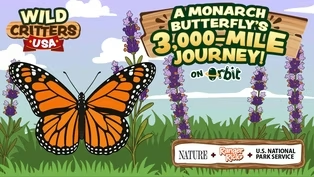
A Monarch Butterfly’s 3,000-Mile Journey | Wild Critters USA
Video has Closed Captions
Follow the monarch butterfly's incredible 3,000-mile migration to Mexico. (29m 9s)
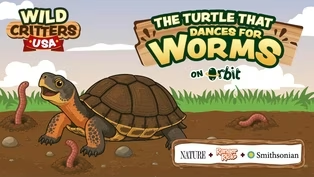
The Turtle that Dances for Worms | Wild Critters USA
Video has Closed Captions
Meet Wanda, the wood turtle who dances to trick worms out of the ground. (25m 47s)
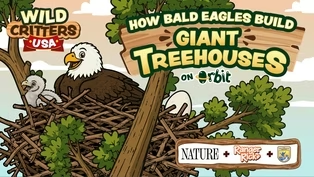
How Do Baby Bald Eagles Learn To Fly? | Wild Critters USA
Video has Closed Captions
Discover how bald eagles build giant nests and learn to fly! (27m 16s)
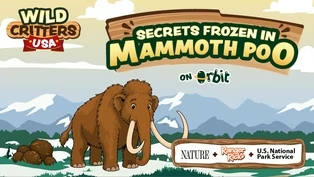
Ice Age Secrets Frozen in Mammoth Poo | Wild Critters USA
Video has Closed Captions
Discover mummified mammoth poop and the Ice Age secrets it holds. (29m)
The Toughest Moms of the Florida Everglades | Wild Critters USA
Video has Closed Captions
Discover the amazing American alligator and the wetlands of the Florida Everglades. (27m 28s)

The Fluffy Guardians of American Grasslands | Wild Critters USA
Video has Closed Captions
Families discover America's largest mammal with Orbit, PBS Nature and the Smithsonian. (30m 4s)
The Tortoise that Saved the Rabbit | Wild Critters USA
Video has Closed Captions
Discover the incredible Mojave desert tortoise on this family episode of Wild Critters. (27m 16s)
Official Trailer | Wild Critters USA
Video has Closed Captions
Explore amazing American wildlife and outdoors in this family podcast series! For kids ages 3-11. (1m 11s)
Providing Support for PBS.org
Learn Moreabout PBS online sponsorship- [Announcer] This episode is part of the "Wild Critter USA" series.
A collaboration with Orbit PBS Nature and the National Wildlife Federation.
(birds chirping) (water splashing) - [Robert] Hey, Hank, what a beautiful day to be in nature next to this little stream.
(dog barks) We've got sunshine, fresh air, and wait, what's that?
(record scratches) There's a sign next to this stream.
It says stream closed for cleaning.
Huh?
That can't be right.
How do you clean a stream?
(gentle music) (dog barks) No, Hank, I don't think they use a giant river mop.
So who exactly is doing the cleaning?
(dog barks) What?
A team of underwater janitors?
Now you're just making things up.
So who exactly is cleaning this stream?
Let's look for clues.
(water splashes) I don't see any buckets.
There's no soap.
I don't see any giant scrubbing brushes.
(dog whining) What is it, Hank?
You found the cleaning crew?
Where?
Those little rocks?
(dog barking) Wait, you're telling me those little shell looking things sitting in the mud are cleaning this stream?
I'm not convinced, but I am curious.
(upbeat music) Hey, Orbiters.
Today we're going to learn about one of the most important animals that you may have never even heard of, freshwater mussels.
And you Orbiters sent in some really great questions.
- [Naomi] How can fresh water mussels hear their predators?
- [Josh] Why do mussels get so dirty?
- [Emily] How do fresh water mussels help the water?
- [Robert] We have an awesome expert who's going to help us out learning about these amazing animals.
His name is Mr.
Tyler and he's from the US Fish and Wildlife Service.
I can't wait to find out more about who's cleaning this stream, but first, let's go see our friend Luna.
Well, Ms.
Luna, welcome back to Orbit.
(upbeat music) (group clapping) - [Luna] I'm so excited to be here.
- [Robert] Yeah, we're excited to have you.
Hey, Ms.
Luna, I am pretty sure that I've heard questions from you on some of our Spanish podcasts like "Camaleon", right?
- [Luna] Yeah, you probably have.
- [Robert] So if you listen to "Camaleon", you must speak two languages.
- [Luna] Yeah.
- [Robert] What languages do you speak, Ms.
Luna?
- [Luna] English and Spanish.
(dramatic acoustic guitar music) - [Robert] And where do you speak English in your life?
- [Luna] I speak English in school activities and in some libraries sometimes.
- [Robert] Oh, interesting.
And when do you use Spanish?
- [Luna] I use Spanish at Spanish Club.
I have a Spanish club at school sometimes and home.
- [Robert] What about with your cats?
Do you speak to them in English or Spanish?
- [Luna] Spanish.
(cat meows) - [Robert] So why does your family speak Spanish?
- [Luna] We're from the Dominican Republic.
(upbeat Latin music) - [Robert] Oh, interesting.
Ms.
Luna, I think it's a superpower that you can speak two languages.
When I was growing up, I only spoke English.
I would love to know what's it like for you to be able to speak two languages?
- [Luna] It's really fun because you get to speak to friends that speak Spanish and teach friends, translate to them and read in Spanish.
- [Robert] That is so cool.
Well, Ms.
Luna, I bet we have some curious Orbiters who either speak Spanish or who are learning Spanish.
Do you have a message for them?
(Luna speaking in Spanish) - [Robert] And can you translate that to English for us?
- [Luna] Keep learning Spanish or English and one day you can teach your friends.
(group clapping and cheering) - [Robert] Amazing.
Well, thank you for sharing a little bit about this superpower of yours with us.
(upbeat music) Ms.
Luna, today we are going to learn about an amazing little critter called a freshwater mussel.
One of a freshwater mussel's superpowers is that they are super good at cleaning water.
(water splashing) - [Luna] If we had a pond right next to us that's always dirty, we could, we could just put our fresh water mussel in the pond and then we can drink out of the water.
- [Robert] Then it would be clean.
That's right.
It would help to clean the water.
Let's say that you had the superpower of cleaning.
What would you use it for?
- [Luna] I would use it to clean everything so that no one would get sick.
(nose blowing) Or if food fell on the floor, you could still eat it up.
(food thudding) (Robert laughs) - [Robert] I love both of those.
So one of them is like you would prevent people from getting bacteria and viruses.
- [Luna] Mm-hmm, so that no one would die.
- [Robert] All right, and the other one, what kind of food when it falls on the floor are you like, oh, I wish it wouldn't have fallen on the floor?
- [Luna] I just love my bananas and I love eating pasta.
- [Robert] Okay, so when you're eating your pasta with bananas on top and it falls on the floor, (laughs) you can clean that up.
All right, I don't think you actually put bananas on your pasta based on the face that you're making.
- [Luna] Actually, no.
I would clean my cat's poop.
(cat hisses) - [Robert] Yeah, yeah.
- [Luna] But that'd be really important.
(Robert laughs) - [Robert] Okay, and are there things about freshwater mussels that you're interested in learning today, Ms.
Luna?
- [Luna] Why do they clean the water?
And how do they help water?
And how do they even move?
- [Robert] We're going to learn a lot about how they move around and how they use... It's kind of like their tongue.
They call it their foot though.
But it is, it's more, it looks more like a tongue, doesn't it?
- [Luna] Yes, it looks like my tongue.
- [Robert] Yeah.
(upbeat music) All right, Ms.
Luna, would you like to help introduce our guest today?
- Yeah.
- Okay.
Today's guest is Mr.
Tyler from the US Fish and Wildlife Service.
- [Luna] Hi, Mr.
Tyler.
Welcome to Orbit.
What do you do for work?
- [Tyler] Hi, Orbiters.
My name's Tyler Hem.
I work as a hatchery complex manager for the US Fish and Wildlife Service.
Our agency's mission is to work with others to conserve, enhance, and protect fish, wildlife, and plants and their habitats for the continuing benefit of the American people.
- [Robert] Hey, Mr.
Tyler, what do you do with the US Fish and Wildlife Service?
- [Tyler] Within that agency, my job is to oversee two fish hatcheries, Irwin National Fish Hatchery and Chattahoochee Forest National Fish Hatchery.
That means I get to help raise and protect some of the coolest animals in our rivers and streams, including freshwater mussels.
- [Robert] Hey, Luna, are you ready to learn about freshwater mussels?
- [Luna] Let's do this.
- [Robert] Woo, let's go.
Hey, parents, did you know we have free coloring pages for all our episodes?
It could be a great activity for your little ones while they're listening and learning.
The link to the downloadable pages is in the show notes.
(upbeat music) All right, let's start learning together.
(dog barks) - [Lancy] Hi, my name is Lancy.
I am seven years old.
I live in Indio.
And my question is what are water fresh water mussels?
- [Nylam] Hello, I'm Nylam.
I'm seven years old and I live in Houston, Texas.
And my question is, how will mussels different come from clams?
Bye.
- [Tyler] That is a great question, Orbiters, and it's one we get a lot.
So freshwater mussels are animals that live on the bottom of rivers or streams inside hard shells.
They're kind of like nature's little water filters.
- [Robert] Mr.
Tyler also told me that clams are kind of like the cousins of mussels.
They're a little bit more round than mussels, and more often they live in saltwater, like on the coast of the ocean.
(upbeat music) - [Cam] Hello, my name's Cam.
I live in Italy.
And my question is why aren't fresh water mussels in the water?
- [Josh] Hello, my name is Josh and I'm four years old.
And I live in Houston, Texas.
My question is, why do mussels get so dirty?
- [Tyler] That's an awesome question.
So mussels live in the water because they breathe and eat by pulling water into their bodies and filtering it.
They get dirty because they bury themselves in the river bottom, the mud, the sand, the gravel, the rocks, whatever it is.
And they only leave a tiny part of their body sticking out and that's where they suck in the water that they filter for breathing or feeding or reproducing.
They act that way because it's their way of staying safe or hidden while doing what they do.
- [Robert] Do any of you orbiters like getting dirty?
You might be part freshwater mussel.
(alarm buzzes) Okay, maybe technically not, but you and mussels can both enjoy playing in the dirt.
(upbeat music) - [Jeffrey] Hi, my name is Jeffrey.
I'm 10 years old.
I live in Warsaw, New York.
And my question is what are the body parts of a mussel?
- [Tyler] I love that question.
And so imagine holding a kind of flattish, could be smooth, could be a bumpy river rock, but on the inside there's an actual living animal.
Some people actually call freshwater mussels living rocks.
- [Robert] Living rocks?
Kind of like our pet rock Walter from a few episodes ago, Hank.
(dog barking) Okay, Walter was an actual rock, so he wasn't alive, but in my imagination he was.
(upbeat harp music) Okay, these mussels are actually alive.
What are their body parts?
- [Tyler] A mussel has a really strong shell that protects its soft body inside the shell.
(bell rings) So besides the obvious shell, the part that you can most often see when you lift the mussel out of the stream bed is its foot.
It also has really strong adductor muscles inside the body that help hold its shell closed if it ever needs to close its shell if there's a predator trying to get it.
It also has gills for breathing.
Similar to a fish, it has siphons, which are little tubes that pull water in and pump water out of the body, kind of like a straw that we use to drink out of a cup.
(upbeat music) - [Robert] Hey Orbiters, pop quiz.
Do you think mussels are a type of fish?
Is the answer A, yes, because they live in the water?
Or B, no, because they don't have a backbone.
Shout out your guess.
If you picked B, you were right.
(group cheering and clapping) Mussels are a type of animal called a shellfish.
- [Group] Ooh.
- [Robert] But even though they're called shellfish, they're not fish at all.
Scientists define a fish as an animal that lives in the water, has a backbone, breathes with gills, and usually has fins like sharks and salmon and bass and swordfish.
Shellfish, like mussels and clams, don't have a backbone, so they can't be a fish.
Hey, while we're learning about mussels' bodies, that reminds me of this question that Damica sent.
(upbeat music) - [Damica] Hello, Orbit.
My name is Damica.
I am nine years old.
I live in Venezuela and I want to know how the mussels stick to rocks and boats.
Thank you.
- [Robert] It turns out there are some species of mussels called marine mussels that can stick really tightly to rocks, docks, or even boats.
(boat horn blowing) Freshwater mussels are a little bit different.
They usually bury themselves in the sand or in mud instead, but I thought this question was so interesting that I had to learn more.
We brought it to our friend, David Mizujewski.
Mr.
David is a science advisor for "Ranger Rick" magazine from the National Wildlife Federation and is helping us out with this "Wild Critter" series.
Hey, Mr.
David, how do mussels stick to rocks?
- [David] Great question, Damica.
Mussels are so cool.
They don't have arms or legs to hold onto things like you or me.
So instead, they grow special threads outside their shell that allow them to attach to solid surfaces.
The threads are really strong and they stick to surfaces like glue.
But unlike the glue that you might use in a craft project, it doesn't dissolve or wash away in the water.
That means the mussel can stick in on place where it filters food right out of the water.
(upbeat music) - [Robert] Hey parents, if your family would like to continue learning about awesome animals like shellfish, "Ranger Rick" magazine has some great resources for families.
I'll leave a link in the show notes.
- [Margaret] Hello.
My name is Margaret and I'm eight years old.
I live in North Carolina and my question is what is exactly a mussel foot and how do they move with it?
- [Robert] I think we all know the answer to this, right, Orbiters?
The mussel's foot is where the mussel puts on its shoe every morning before it goes to school.
But I don't think mussels have hands, so I don't know how it ties its shoelaces.
(dog barks) It probably can only wear cowboy boots that don't have any shoelaces.
(dog barking) Fine, fine, Hank.
I don't actually know what the foot is.
All right, can you help us out, Mr.
Tyler?
- [Tyler] That is a great question, Margaret.
So a mussel's foot isn't like our feet with toes.
It's more like a strong, stretchy, thick, tongue-shaped muscle inside the shell.
The animal pushes its foot out in the direction that it wants to move and then it pulls its body toward where it's holding onto.
So it's a really slow way of moving when we think about it like walking down the street, but it works well for mussels and they've been doing it for a long time.
- [Robert] Kind of amazing that an animal can be designed to move so slow on purpose.
(upbeat music) - [Jason] Hi, my name is Jason.
I am nine years old.
I live in New York.
My question is where are the eyes of the mussels?
- [Naomi] Hi, my name is Naomi and I'm nine years old.
And I live in New Rochelle, New York.
My question is how can freshwater mussels hear their predators?
- [Robert] These are some really great questions.
Hey, Mr.
Tyler, we humans have five senses, (bell rings) sight, smell, taste, touch, and hearing, which is how we get information about the world around us.
Jason, Naomi, and I are wondering if mussels have the same senses as us.
- [Tyler] These are great questions about how these animals behave and a lot of people don't know about because these are so mysterious creatures.
Mussels, even though they don't look like they're doing much, they actually can sense a lot of things.
They can feel vibrations.
They can smell or taste chemicals in the water.
They can detect changes in light.
And we're currently researching some of these things and that we hypothesize that they can actually sense and field really small changes in water pressure.
- [Robert] Water pressure means how hard the water is pushing on something.
- [Tyler] So mussels don't have eyes like we do.
Instead, they have these tiny light sensing spots all along the edge of their body that sticks out of the riverbed.
They don't see images like you and I do, but they can sense brightness.
So think of like shadows moving across a field.
This really helps them sense when something's swimming overhead.
- [Robert] And what about ears?
Can they hear?
- [Tyler] So they can't actually hear like we do.
They don't have ears.
What they are able to do is feel vibrations in the water.
Little tiny vibrations that we would never be able to sense.
- [Robert] Well, that's weird.
Why would they only want to be able to see shadows and sense tiny vibrations?
- [Tyler] So if it's fish or a turtle or a biologist swims by a mussel, it can sense those vibrations in the water and it can decide, oh, I'm going to close my shell and be more protected.
(air pops) We humans can't feel those vibrations in the water that a fish or a mussel can.
There are all these interactions going on in the natural world that humans don't see or feel in the animal world as most of their time is spent sensing and detecting things that we can't see or hear or feel.
That always fascinates me.
- [Robert] So even if the mussels can't see and feel the same way we do, they have their own super sensing powers evolved over a long, long, long time to help them survive.
Hey Orbiters, let's take a little break for a mystery sound.
(upbeat music) You can wiggle while you listen and think about what the sound is.
(air rustling) Here's a hit.
This object doesn't have arms, but it spends all day waving at people.
(air rustling) Stick around to the end for the answer.
Okay, let's get back to more questions.
- [Ellie] Hello, my name is Ellie and I'm five years old and I live in Boston.
And my question is where do mussels come from?
- [Robert] Pay attention closely, Orbiters.
(suspenseful music) These little living rocks may seem simple, but they go on one of the most incredible baby journeys in the whole animal kingdom.
- [Tyler] I love this question, Ellie.
Thank you so much.
So imagine a teeny tiny mussel that's called a glochidium.
- [Robert] So a baby mussel is called a glochidium also pronounced glochidium.
Wanna try to say that word with me?
Glochidium.
On the count of three, one, two, three.
Glochidium.
- [Tyler] And it's so small that you could fit thousands and thousands of them into a teaspoon.
They're sometimes even smaller than grains of sand.
So first imagine you start inside your mother's shell safe and snug.
Mama mussels have special gill pouches that hold the baby mussels.
After a while, your mom releases you into the water.
- [Robert] Sounds kind of like she spits them out.
- [Tyler] So once you leave mom, you actually have one really, really important job and that's finding a ride on a fish.
(water splashing) - [Robert] So the fish is kind of like a school bus, but for a glochidium.
(bus engine hisses) (bus doors clicking) - [Tyler] So glochidium actually snap onto the gills or fins of passing fish.
It doesn't hurt the fish.
And the mussels actually ride along as a little hitchhiker, either on the gills or on the fins.
Sometimes it maybe only be a week or two and sometimes it might be much longer.
- [Robert] So the fish just swimming around doing its fish thing and the glochidium are along for the ride.
(glochidium cheers) - [Tyler] And this is a really dangerous journey because as a baby mussel, you can't do much on your own.
And so after a while, one day when you're ready, you drop off and you drift to the bottom of the river or lake or stream or creek, wherever you are.
If you're lucky, you'll settle to the river bottom to start your life as a young mussel.
It's one of the wildest journeys in all of the animal world.
- [Robert] But it gets even better.
Our friend Kenji asked a question that is going to blow your mind.
(upbeat music) - [Kenji] Hi, Orbit.
My name is Kenji.
I'm six years old.
I'm from Pasadena, California.
And I would like to know what is mimicry?
Bye, Orbit.
- [Tyler] Love this question.
Thank you, Kenji.
So mimicry is when an animal looks or acts like something else to trick another creature.
- [Robert] Like Hank when it's bath time and he is mimicking being a rug so that I don't see him.
(dog barks) Okay, not exactly.
But what does mimicry have to do with mussels?
- [Tyler] So mama mussels are experts at this.
They wave parts of their bodies that look exactly like little fish or bugs.
And when the fish attacks that lure, the mama mussel releases her babies right next to the fish so that they're really close and the mussels have the best chance of hitching a ride on that fish.
- [Robert] So imagine you're a hungry fish swimming along.
Suddenly you spot what looks like the most delicious snack you've ever seen.
It's dinnertime.
(bell ringing) You race over to gobble it up.
But surprise, it wasn't a bug at all.
It was a mama mussel.
And at that exact moment, she releases thousands of tiny baby glochidia right next to the fish.
(bell chimes) Some of those baby mussels latch onto the fish's fins or gills and they begin their incredible journey.
Pretty sneaky, huh?
(upbeat music) - [Emily] Hi, my name is Emily.
I'm nine years old.
I live in New Rochelle, New York.
My question is, how do fresh water mussels help the water?
- [Luna] Hi, my name's Luna.
I'm six years old and I live in New York.
And my question is why are mussels so important for rivers?
- [Tyler] Thank you so much, Emily and Luna.
So mussels are like living water filters.
They suck in water, they clean out dirt and algae and tiny particles, and then they spit the clean water back out.
They also create little habitats for insects and fish that keep riverbeds stable and act as indicators of how healthy a river is.
It's like giving a river its cleaning crew back.
- [Robert] This means mussels are super important, but mussels are also in trouble.
Sometimes humans change rivers and streams.
For example, when we build dams that change how deep the water is or how fast it moves, or when pollution changes the types of animals that live in a river, it can make it harder for mama mussels to find the special fish to put their babies on.
And that means fewer baby mussels survive.
We'll learn in a little bit how scientists like Mr.
Tyler are helping to save mussels, but how about we check in real quick with our friend Luna?
(upbeat music) Hey, Ms.
Luna, are you ready to take a short break and stretch and move around a little bit?
- [Luna] Yeah, let's do it.
- [Robert] Woo.
Okay, what kind of movement should Orbiters do today?
- [Luna] I think they should do a hippo.
- [Robert] How does a hippo move?
- [Luna] Pretend that you're in the water, get on your hands and knees, crawl around and make hippo noises.
- [Robert] (laughs) Okay.
Well, I have no idea what a hippo noise is.
That would be a good mystery sound for an episode.
What is a hippo sound?
(Luna grunting) - [Luna] This sound.
(Robert laughs) - [Robert] It kind of sounds like you're snoring.
Okay.
And if it is an Orbiter's second or third time listening to the episode, how should they change it up?
- [Luna] After you get out of the water, shake your head like crazy from side to side and get the water out of your ears like a hippo.
- [Robert] (laughs) Okay, so the first time it's like you're in the water and the second and third time it's like you're coming out of the water and you're shaking out all the water.
- [Luna] And that also pops their ears open after they go underwater.
- [Robert] You are full of animal fun facts.
And while we're acting like hippos, let's recap what we've learned.
We learned that freshwater mussels are animals, not rocks, and that they live at the bottoms of rivers and streams where they use gills and special tubes called siphons to filter water for food and oxygen.
Mussels also have a foot that helps them move slowly, even though they don't wear cowboy boots.
We also learned that baby mussels called glochidia go on an incredible journey by hitching a ride on a fish before settling onto the river bottom and growing up.
Mussels are also important river helpers because they help filter water, create habitats for other animals, and help scientists understand whether a river ecosystem is healthy.
Hey, Mr.
Tyler, you said you work in something called a hatchery.
I think we all want to know what in the world is a hatchery.
- [Tyler] So a hatchery is a special facility where we raise young mussels until they're strong enough to survive in the wild.
We help mussels by raising them through their tricky early life stages so that they can grow big and tough before we put them back into the environment.
- [Kenji] Hi, Orbit.
My name is Kenji.
I'm six years old.
And my question is, how is it like to work in hatchery?
Bye.
- [Tyler] Thank you, Kenji.
This is a great question.
And so working in a hatchery is a mix of science, teamwork, mud, slime, lots of excitement.
- [Robert] Hank and I love all those things.
(dog barking) - [Tyler] Some people care for fish, some raise mussels, some raise crayfish, some monitor water quality, and others help release animals back into the wild.
One thing that we do at my hatcheries is we often are studying the host fish for these mussels.
Some species of mussels require a very specific species of fish, and we as scientists need to understand that so that we can have the best chance of producing the most mussels to help these species out.
And so every day at a hatchery, you get to really make a difference in helping rivers stay healthy.
- [Robert] These hatcheries sound awesome.
Hey, Mr.
Tyler, how can families continue to learn about freshwater mussels and river ecosystems?
- [Tyler] Great question.
You can visit a nearby national fish hatchery or a national wildlife refuge, talk to biologists about mussels.
You can visit local rivers and creeks, look for mussel shells that are on the bank.
You can join a community cleanup, explore nature centers, and generally just keep carrying and asking questions about freshwater ecosystems that we rely on as humans for so many things.
And so much of the natural world relies on these freshwater ecosystems.
And remember that healthy rivers start with the choices that we make every day.
- [Robert] That is so true.
We can all make decisions that help keep our rivers clean.
Hey, Mr.
Tyler, I hear you have a couple of Orbiters in your house.
- [Tyler] Love to send a special shout-out to my two little orbiters, Martin and Brooks at home.
- [Robert] Hi, Martin and Brooks.
And thank you for joining us on Orbit today, Mr.
Tyler.
- [Tyler] Thank you so much Orbiters for exploring with me today.
And I would just say keep asking questions, keep being curious, and don't be afraid to get a little muddy.
Nature's full of surprises and all you have to do is look.
- [Robert] Hey, parents.
Our guest today was Tyler Hem.
Tyler oversees Irwin National Fish Hatchery and Chattahoochee Forest National Fish Hatchery with the US Fish and Wildlife Service.
We'll include some cool resources in the show notes that Tyler shared with us to continue learning about mussels.
Also, if you want to do something fun and family, try saying National Fish Hatchery three times fast.
Hey, before we wrap up, I bet a few of you are curious about the mystery sound.
Do you remember it?
(wind rustling) If you said it's a flag flapping in the wind, you were right.
Way to go.
All right, let's go check in with Luna one last time.
(upbeat music) Hey, Ms.
Luna.
We have learned a lot today about freshwater mussels.
Was there something that you though was interesting?
- [Luna] It's foot.
You mostly only see its foot when you lift it out of a stream bed.
- [Robert] Yeah.
I thought the foot was really interesting too because it's so different from our feet.
- [Luna] They're more like sticky and stretchy.
- [Robert] Yeah, sticky, stretchy, kind of like tongues.
(laughs) Luna is, Luna is sticking her tongue out at me right now.
I'm not going to take that personally.
I think you're just showing me what a mussel does.
You're not, you're not making fun of me.
Hey, before we say goodbye, why don't we give families a conversation starter?
- [Luna] Oh, would you rather, to fight off enemies, would you rather puff up like a puffer fish or sting like a man o' war?
- [Robert] Ooh, that's very interesting.
Hey, what's a man o' war?
- [Luna] A man o' war is a purply gelatiny animal.
It lives in warm weather and it, it has really tentacles.
- [Robert] So it, it looks kind of like a jellyfish, but it's not a jellyfish, right?
- [Luna] Yeah, it's not jellyfish.
- [Robert] Yeah.
Okay, families can have a conversation about would they rather puff up like a puffer fish to defend against predators or sting like a man o' war?
And Luna, we are about to wrap up this episode.
Do you have a joke or a riddle for Orbiters today?
- [Luna] What goes one shellfish say to the other?
- [Robert] All right, Orbiters, what does one shellfish say to the other shellfish?
(sighs) I do not know.
Again, one day I'm going to get one of these right, but that day is not today.
Luna, what does one shellfish say to the other shellfish?
- [Luna] Shall we play?
(Luna laughs) - [Robert] Shall we play.
Oh, shell we play.
(Robert and Luna laughs) Amazing.
And any final messages for our listeners, Ms.
Luna?
- [Luna] If everyone picks up one piece of trash every day, that will make a big difference in the environment.
(bright music) - [Robert] What a great message.
I'm going to try to do that today.
Thank you for the inspiration.
All right, everybody.
We'll se y'all next week.
- [Luna] Bye-bye.
- [Robert] This episode is part of the "Wild Critter" series.
a collaboration with our friends at PBS Nature and the National Wildlife Federation.
Orbit is produced by Cumbre Kids.
This episode was written by me, Robert Carpenter.
The producer is Gerwuin Riera.
Artwork for the episode by Moises Monsalve and Jorge Wake.
We'll see you in the next episode.
Ciao.
- [Luna] "The important thing is not to stop questioning."
Albert Einstein.
The end.
(upbeat music)
 New Episode
- Science and Nature

Explore scientific discoveries on television's most acclaimed science documentary series.


 New Episode








Support for PBS provided by:
Major support for NATURE is provided by The Arnhold Family in memory of Henry and Clarisse Arnhold, Sue and Edgar Wachenheim III, Sarah and Sandra Lyu in memory of Seung...