
Snakes: Snake Food
Clip: Special | 1m 4sVideo has Closed Captions
Snakes can open their mouths very wide. Why?
How do snakes find their food? They have special organs to help them. They can eat food twice their size and, by the way, they don’t chew. Find out more about snakes and their food.
Problems playing video? | Closed Captioning Feedback
Problems playing video? | Closed Captioning Feedback
Science Trek is a local public television program presented by IdahoPTV
Major Funding by the Laura Moore Cunningham Foundation and the Idaho National Laboratory. Additional Funding by Sparklight, the Friends of Idaho Public Television and the Corporation for Public Broadcasting.
Snakes: Snake Food
Clip: Special | 1m 4sVideo has Closed Captions
How do snakes find their food? They have special organs to help them. They can eat food twice their size and, by the way, they don’t chew. Find out more about snakes and their food.
Problems playing video? | Closed Captioning Feedback
Where to Watch Science Trek
Science Trek is available to stream on pbs.org and the PBS app.
Science Trek
Science Trek is a place where parents, kids, and educators can watch short, educational videos on a variety of science topics. Every Monday Science Trek releases a new video that introduces children to math, science, technology, engineering, and math (STEM) career potentials in a fun, informative way.[MUSIC] JOAN CARTAN-HANSEN, HOST: How do snakes find their dinner?
Well, some have a special organ located near their eyes.
It helps them to detect small changes in temperature.
That helps them to find heat given off by bodies of rodents or other animals they might want to eat.
Yum.
Snakes can eat animals twice their size.
That's because they can open their jaws extra wide.
The bottom of a snake's jaw is only loosely attached to its skull, rather than to its top jaw.
Most snakes don't chew their food, instead they swallow their prey whole.
Some snakes, like boas and pythons are called constrictors.
They catch their dinner by coiling their bodies around their prey and squeezing until the animal stops breathing.
And some snakes, like cobras and rattlesnakes, shoot a poison called venom into their prey.
The venom weakens or kills their dinner.
And then, they can swallow it whole.
Venomous snakes rarely bite humans.
They only lash out when they think they are in danger.
So, if you see a snake in the wild, stay well away so it can find dinner on its own.
For more information about snakes, check out the Science Trek website.
You'll find it at ScienceTrek.org
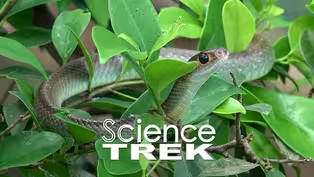
Video has Closed Captions
Clip: Special | 1m 4s | Don’t like snakes? Here is where you can live to avoid them. (1m 4s)
Providing Support for PBS.org
Learn Moreabout PBS online sponsorship New Episode
- Science and Nature

Explore scientific discoveries on television's most acclaimed science documentary series.


 New Season









Support for PBS provided by:
Science Trek is a local public television program presented by IdahoPTV
Major Funding by the Laura Moore Cunningham Foundation and the Idaho National Laboratory. Additional Funding by Sparklight, the Friends of Idaho Public Television and the Corporation for Public Broadcasting.