
Something to Call Our Own: A CHamoru Dance Story
Something to Call Our Own: A CHamoru Dance Story
Special | 57m 20sVideo has Closed Captions
A compelling documentary on the origins, obstacles, and evolution of modern CHamoru dance.
From the small island of Guam to the international stage of FestPAC, the documentary showcases the inspiring story of cultural revival, resilience, and the ongoing journey to reclaim and preserve a tradition that belongs to the CHamoru people. At the heart of this revival stands Master Frank Rabon, who dared to reimagine a lost tradition, giving it back to the generations who longed for it.
Problems playing video? | Closed Captioning Feedback
Problems playing video? | Closed Captioning Feedback
Something to Call Our Own: A CHamoru Dance Story is a local public television program presented by PBS GUAM
Something to Call Our Own: A CHamoru Dance Story
Something to Call Our Own: A CHamoru Dance Story
Special | 57m 20sVideo has Closed Captions
From the small island of Guam to the international stage of FestPAC, the documentary showcases the inspiring story of cultural revival, resilience, and the ongoing journey to reclaim and preserve a tradition that belongs to the CHamoru people. At the heart of this revival stands Master Frank Rabon, who dared to reimagine a lost tradition, giving it back to the generations who longed for it.
Problems playing video? | Closed Captioning Feedback
Where to Watch Something to Call Our Own: A CHamoru Dance Story
Something to Call Our Own: A CHamoru Dance Story is available to stream on pbs.org and the PBS app.
Håfa adai, todu mauleg.
How are you?
Håfa adai, todu mauleg.
Thank you.
Håfa adai, todu mauleg.
How are you?
Håfa, håfa, håfa, håfa adai.
Håfa, håfa, håfa, håfa adai.
Suva, capitol of Fiji, welcomes performers to the firs South Pacific Festival of Arts.
In a magnificent ceremony in Albert Park, the sacred tambua, and a bowl of yagona, or 'kava' is presented to the Governor General, Sir Robert Foster.
In May 1972, the island nation of Fiji joyously welcomed the opportunity to host the first South Pacific Festival of Arts.
Initiated by the Pacific community, SPC, it brought together over 1,000 participants from 14 countries in the region.
♪"Colorful Hues"♪ Jonah Hånom [EILEEN] FestPAC is an opportunity for the 28 nations to come together to share their indigenous cultures.
And it allows for us to just celebrate who we are as a people for those two weeks.
♪ I had a vision you were in my room ♪ ♪ in the middle of the afternoon ♪ ♪ Just laying in bed.
Playing with my head ♪ ♪ Thinking we got nothing better to do ♪ [BENJIE] FestPAC for a cultural enthusiast is the candy store for that kid who just thrives on gummy bears, hard candy, all of those different sweets.
♪ The sun's glimmering down ♪ ♪ Maybe we go paint the town ♪ ♪ with colorful hues ♪ ♪ That sound like wonderful news ♪ [BRIAN] What Tumon showcases to the tourists cannot compare to the caliber of the Festival of Pacific Arts.
[BENJIE] Man, everything and everyone at FestPAC is the epitome of culture running through their veins.
You see the most indigenous of indigenous cultures.
From theatrical presentations to chanters to tattoo artists to massage therapists to storytellers, you'll find all of them there.
♪ Red like a fire heart's burning desire ♪ ♪ Blue like a water cool down getting hotter ♪ ♪ Golden body with the lips like fuschia ♪ ♪ Babygirl you've got the colorful hues ♪ ♪ Ima say again ♪ ♪ Red like a fire heart's burning desire ♪ ♪ Blue like a water cool down getting hotter ♪ ♪ Golden body with the lips like fuschia ♪ ♪ Babygirl you've got the colorful hues ♪ ♪ You've got the colorful hues ♪ [BRIAN] One night, Uncle Frank called all the teachers early that morning and he goes "Get ready, because we're going."
And when uncle Frank speaks, we don't question.
We just go.
So we got into a bus and we didn't know where we were going.
Solomon Islands does not have great electricity, so it was really dark.
We came to a beach and we sat down with all the other delegates.
Different groups are chanting, singing and dancing.
And then all of a sudden, when the sun started to rise.
In the horizon, you can see all of the canoes from the differrent Polynesian and Melanesian islands that traveled from their island to Solomon Islands for the start of the Festival of the Pacific Arts.
That was the very first moment that I was just like, "Oh my God, I am s proud to be a Pacific Islander."
[FRANK] They wanted the islanders to come together and address and discuss the issues that's happening to their language and culture.
The erosion that's been happening because of colonization, because of Western ideals, because of technology, because of all these change that are happening in our world.
So that the islanders can come together share each other's stories and way of life, and see what kind of solutions they could come up with in the preservation of thei indigenous language and culture.
[EILEEN] My role as a 2024 delegate for FestPAC is, number one, I'm a chairperson, but I'm also the performing arts director for songs, chants and dances.
[NATIVE CHAMORU CHANT] [EILEEN] So my responsibility is to make sure that the members are aware of the history of their dance, the style of their dance, knowing what it is that they're singing, knowing- Making sure that they are well-rounded in everything that it is that we're doing.
So the choreography thus far is based off of the migration of our people, when they first migrated to Guam, the interpretation of that and the evolvement of our dances throughout history.
I was able to have the opportunity to grow up with my grandmother.
She was a farmer in her time and my father and his brother are fishermen.
Growing up I was afforded the opportunities to witness the farming skills, the methods of fishing.
And so I'm able to take that knowledge and create dance based off of the life that I was taught as a young person growing up.
What we are doing is very young.
I always tell our community of people that our dances are still in its baby stage.
It's still in its baby stage, and we need to be very careful and still respect our Pacific brothers and sisters in their work.
We need to understand that Frank Rabon took a step in a direction that led us to where we are today.
And we are 40 years still young.
That's why it's like a baby.. And we need to be cognizant of that and mindful of what it is that we're trying to portray.
[MAXINE] I wanted to tak whatever it is that I've learned and the way Frank has nurtured us as his students, and pass it on to my students.
And everything, of course, for us, it started with love.
Loving who you are.
And that's building pride through whatever it is.
If sitting next to me and you talking to me is going to help build our love for who we are, then let's sit down.
Let's sit down and get inspired by the tree swaying, the ocean moving, the kids playing, mom and dad doin what it is that they're doing, the celebration of life that's going on around us.
[VINCE] What's important is that our kids understand exactly what they are learnin and what they are dancing about.
So I always tell them, we need to try as much as possible to live those moments when we are performing, that we're living that particular dance.
We don't know who's going to watch us.
And for the 20 minutes, 30 minutes that we are performing, we get to bring them to our world.
And that's a big responsibility, especially if you're international and you're traveling internationally and people don't know where Guam is.
So for me, what I felt was where I can contribute was how that I felt that I was able to provide a different creative angle on CHamoru dance using the same basic steps that everyone else was using, using the same formulas, but just being able to elevate the experience.
What I wanted to do also was popularize it and make it reachable for our kids.
Because a lot of times we - the presentations we don't get, and we don't understand what's happening.
And then sometimes it even makes us feel uncomfortable.
It's so overwhelming.
Because we all feel that culture is there.
Over there.
And only cultural dancers do that.
And cultural practitioners are there.
And it's overwhelming fo a student who wants to come in and say, "Well, I don't want to just do that.
I'm more than that as a CHamoru.
And so how do I again, first become that mirror?
How can I be the connecting point to an identity?
And I do that through music and dance.
There needs to be a an openness to cultural expressions in different ways.
And sometimes that doesn't rub well with certain people.
Because some want to have it one way and only one way.
And if you don't do it that way, you're wrong.
[BOBBIE] We have our signature styles.
Everybody though when we get together, we all stick to one standard.
So if I did the dance mov this way in my cultural house, when I go to Master Frank Rabon or Master Eileen Meno I do it that standard way; the way it was created.
If we're trying to build traditions then traditions should start with the standards and that will basically have our consistency throughout our dance groups.
And that's we dance the same, we sing the same.
We're going to look the same.
And that way when people say, "Oh, that's not tradition."
I'm like "Oh.
Well we've bee doing it for the past 29 years."
And sometimes I feel - there are many times where I felt very ostracized because everyone was doing it this way and because I wasn't doing it this way, I was wrong.
But when I turn around and I say "What is right?"
They will say everything that they're doing.
But I don't believe that.
So.
[BRIAN The Tribal council will always call the houses together like for FestPAC and every time we call the houses together they always understand And they know tha the style that they're dancing is the style that has bee started by teacher Frank Rabon.
[BOBBIE] I did a lot of Guam Dance Academies with him and I'd pick his brain I'll ask him all kinds of stuff.
"Kiko, why did you do the Bachelor dance?"
"Why did you create the dance of life?"
"Why did you do this?"
And I had to ask him those times, because sometimes I forget that I didn't even ask him and I'm just doing the dance, I'm like, "Man, I don't even understand why."
Until I finally asked him.
He is making sure that we're prepared that when we go out and people are challenging the dance of life saying "Why are you doing the dance- [IN NATIVE CHAMORU] Why are you doing the dance of life?"
Why are you doing the dance of life?"
That is my time to say "Wait, wait.
Wait a minute.
Let me show you exactly why we do this."
So of course, where do we come from?
We come from maybe the heavens.
We come down to earth and we live our life.
And once we're done, where do we go?
We go right back up.
And that's a full circle.
That's exactly why we do the dance of life.
Why do we do it in eight counts?
If you take a look at the chiefs house, the chief's house.
There are 8 latte stones in one row and another 8.
8 plus 8 is 16.
That's 16 count when you do the dance of life.
Why is the women only the ones that do the dance of life?
But the men compliment it?
Because only women can carry life.
The bachelors.
In one of the writings from the Spanish acccounts, they saw our people doing a stick dance.
What did Frank do?
He just decided to develop a concept that did a stick dance.
And everybody thinks it's fighting, but we were never fighting to begin with.
How does a young man, a young warrior prepare himself to bring in a wife?
What are you going to do?
You're going to make sure you build your house first.
That's your stability.
That's your foundation.
What is the bachelors dance It's the building of the house.
That's why it's called the Bachelors Dance, because they're preparing those bachelors for when they bring i their wives to live with them.
So Kiko has all these concepts, has all these ideas.
Has anybody ever sat down to talk to him about it?
I'm pretty sure they never did.
Do we know about it?
Yeah, we do.
We do, because we all fall under his tutelage.
And I asked.
[FRANK] In the beginning, people always thought that I was authenticating CHamoru dance.
And I keep telling them "I'm not authenticating.
That's impossible."
What I can do is, based on my upbringing, my way of life as a CHamoru, I can equate that to how I create the dances, okay.
Because it tells the story of my upbringing and my way of life.
What I wanted the - our people, our CHamoru people and the world to know is that we existed.
The CHamorus existed in the Marianas.
4,000 years ago.
We cannot be relegated to just the history books, and we cannot continue to do borrowed dances like the batsu and the jitterbug and the twist and the cha-cha when it doesn't belong to us.
We need to have something that we can call our own.
♪ "ALL-ISLAND" by Straightupjed begins playing ♪ ♪ I got some ops tryna get the best of me ♪ ♪ I am the GOAT from the islands ♪ ♪ Talking bout me in ya head rent free ♪ ♪ I am the one, come and try me ♪ ♪ Call the plug, he got the gas for me ♪ ♪ You want the smoke?
Come find it ♪ ♪ Talking about me in ya head rent free ♪ ♪ I am the one come and try me ♪ ♪ I be all-island ♪ ♪ All them eyes on this ♪ ♪ Get em all excited with a sauce like this ♪ ♪ No cappy ♪ ♪ She call me island boy and daddy ♪ ♪ King s**t ♪ ♪ Roamin with my reigns above average ♪ ♪ Putting islands on the map ♪ ♪ Guam boy, neighbors cooking in the trap ♪ ♪ Pipe dreams,♪ ♪ Turned to damn we living that living that♪ ♪ Type beat, Type dream♪ ♪ Type to get it like that♪ ♪ Iso-lated, I be blessed up♪ ♪ Shout out the islands yeah we next up ♪ ♪ I got some bars for my pars ♪ ♪ I'm from where there's sunshine ♪ ♪ but I'm burning with the stars ♪ ♪ Music starts ♪ [EILEEN] I used to get in trouble a lot from my parents, because I always wanted to go and dance.
And coming from a household of four with one sibling one other sibling, my brother, that meant it took me away fro housework and stuff like that.
I always chose dance.
So initially, I actually started dancing in 1992.
It was a program that was introduced to the students of Inarajan High School at the time.
I was into volleyball, basketball and softball, but once I was introduced to dance and I realized that I really, really enjoyed it.
I kind of moved away from the sports scene and I became more focused in dance.
I literally gave up my athleticism in sports to be a part of this.
[MAXINE] For me, just like her I was at and around high school So for me, just like her, I was at Inarajan High School and the minute [IN NATIVE CHAMORU] The People of the Land, the dancers, started to chant, like, I just had goosebumps.
And I just remember sitting there as a kid just wanting to be a part of them because of how powerful and just proud - there was so much love.
I just felt like my ancestors were sitting right next to me and they were like "Girl, you gotta go.
That's the one, right?"
[EILEEN] I didn't know what CHamoru dance was.
All I knew was that they were offering CHamoru dance with this man, Frank Rabon.
[MAXINE] Frank had Monday through Friday practices at Barrigada Community Center.
We loved the class so much that [BENJIE] we ate it, we slept it, we dreamt it.
We woke up and we did it again.
[MAXINE] And our parents, you know, of course, our parents right.
They're going to think "Oh, Taotao Talan, right?"
Ah no, no, no, no, no.
[EILEEN] What parent is not going to be worried, right?
Because I'm a teenager.
I'm out there.
But I was doing it, because I loved the people I was around.
I was learning the language in a different setting.
I wasn't - the language wasn't spoken to me when I was only getting in trouble.
It was actually being spoken to me in the community setting.
[MAXINE] We were solid as a family.
It was definitely an outlet, a safe outlet that made me feel proud to be who I am as a CHamoru.
[BENJIE] At that time, And because back then there was just one dance group and that was Taotao Tåno', so we didn't have anything else to look at compare ourselves to, that we didn't even know we were going to start any sort of history.
We were just in it just to be in it.
[VINCE I didn't stay long with Frank, so I'm not the one to really talk to about him.
because I wanted to find my journey and and find the voice that I wanted and felt I needed to share.
I was a teacher at Inarajan Middle School, and at Inarajan Middle School, there were these students who just kind of kep coming to my class, hanging out and then I started doing CHamoru month and a little bit of dance.
So I entered this competition called the Dinaña Minagof and it was an islandwide school competition.
And remembe I had no real formal training.
I had a little bit.
I saw some sort of formal teaching.
But again, remember at the time, CHamoru dance was not - [SIGHS] it was beginning the stages of being organized as a CHamoru dance art form.
[EILEEN] And so I trained the students every day.
At the same time I was training them, I was learning how to play the guitar, I was learning how to play the drums, I was learning how to put chants together.
I was learning, you know - I was just going through this learning process at the same time and teaching the kids.
And then it just went from Dinaña Minagof to CHamoru Village calling up and asking for presentations at the Village.
The students at the time, their parents were asking to do presentations at birthday parties and, and it just kind of went on like that.
[VINCE When I felt that CHamoru dance was a calling was when i realized that CHamoru dance to me served a bigger picture than my creative expression.
[EILEEN] Now it's no longer about the competitions.
It's about building relationships with them, nurturing them to have that desire to be proud of who they are and take whatever it is I'm teaching and carry it on with them.
[BOBBIE] I realized that without our language, we're not going to have a culture.
And so that purpose actually became - there was a bigger picture.
[EILEEN] I've always loved CHamoru language although I didn't grow up with it in the school system.
But I was surrounded by i with my elders in my community and then being a part of Taotao Tåno'.
I was able to just kind o see the two and mesh it together because it really was something that could coexist.
[BENJIE] We are the foundation of these children.
We don't know what their past was.
We don't know what their present is, but we can most certainly help them with their future.
[BRIAN So Doctor Benjie Santiago called one day and had asked me, "BJ, would you like to teach in the school system?"
I said, "But Benjie, I have no degree."
And at that time, the Department of Education was looking to hire temporary teachers in the field of CHamoru language and culture.
I went ahead and I took the opportunity to do so.
But personally, I was like, I'm here, I'm hired to be teaching the CHamoru language And I don't even know how to speak my language.
[BOBBIE] The language also cam a little bit, like, later for me I wasn't even speaking CHamoru until I really started to establish myself in my guma.
And I said, "Man, if I'm going to be teaching CHamoru cultural dance, I should speak CHamoru too."
[BRIAN] Just as a note, the CHamoru dance movement is supposed to be the vehicle that carries the CHamoru language.
And so we use the art of dance and we use the traditional art of weaving an the traditional art of singing and the traditional art of chanting to carry on the CHamoru language.
♪ "SANTA RITA" by Fat Tofu begins playing ♪ When I entered the arena of CHamoru dance And I was was introduced through teacher Frank Rabon, I was able to really grasp and understand the CHamoru movement.
[EILEEN] Frank Rabon is the founder of the Taotao Tåno' Cultural Dance Group.
Back in the 80's, 1983.
He is the Master of CHamoru dance.
♪ Baila, baila Santa Rita ♪ ♪ Baila, baila Santa Rita ♪ ♪ Baila, baila Santa Rita ♪ ♪ Baila, baila Santa Rita ♪ ♪ Baila, baila Santa Rita ♪ ♪ Baila, baila Santa Rita ♪ ♪ Baila, baila Santa Rita ♪ ♪ Baila, baila Santa Rita ♪ [BRIAN] So Uncle Frank is - he is a man of little words.
He speaks in parables.
And sometimes you have to figure it out yourself.
Not sometimes.
I want to say all the time.
[EILEEN] He was this mean gu who just wanted to teach us and in order to get us to do that, he had to touch us in our hearts.
[MAXINE] He showed us that hard love.
If you didn't get the ducks in line, then toka, right?
You're going to get it.
[EILEEN] And so for the two hour that we met with him every day, we were immersed in singing and dancing.
♪ Fly to the sky ♪ ♪ I'm seeing blue in the sky ♪ ♪ For no reason ♪ ♪ There's no reason ♪ ♪ To lie, I can't deny ♪ ♪ You give it up and you lose ♪ ♪ All the marbles you abuse ♪ ♪ For no reason ♪ ♪ There's no reason ♪ [BOBBIE] And I just remember wanting to be around this man who had so much knowledge.
I always told this to him, I said, "Kiko, you are like a walking encyclopedia."
♪ For he without sin, may he cast the first stone ♪ ♪ The stone that's been cast was sent to the unknown ♪ ♪ To another dimension ♪ ♪ For he without sin, may he cast the first stone ♪ ♪ The stone that's been cast was sent to the unknown ♪ ♪ To another dimension ♪ [VINCE] Frank is, you know - he's what we conside the Godfather of CHamoru dance.
He was brave enough to reconstruct it.
[BENJIE] We would not be where we are today if it wasn't for him and his legacy, right.
And planting the seeds.
[IN NATIVE CHAMORU] For planting the seeds for Taotao Tåno'.
[EILEEN] [IN NATIVE CHAMORU] He is my foundation.
[IN NATIVE CHAMORU] He is my latte stone.
He is my foundation.
And he is - he's the man.
As a child, I was always, intrigued by any form of dancing I was born in 195 and already the types of dancing that was happening on our island was mostly the colonized, adaptation that was brought in by the outsiders beginning with the Spanish influence [IN NATIVE CHAMORU] which was the Waltz, the Polka, the Punta Takon, the coconut shell dance, the stick dance.
And then the American mainstream dances that came in after the war, which was like the cha-cha the jitterbug, the jerk the skate, the monkey, all those kind of stuff.
And it was very easy for me to pick it up.
Out of the nine of us in my brothers and sisters, I was the one that would easily just watch a demonstration and I can follow and pick it up immediately.
Because I was raised with it, I figured that that was the only form of dancing that we CHamorus were exposed to.
Throughout my school days in the public school system, we were inundated by American teachers.
So we were being colonized t the point where we were forced to learn a lot of American and Western influences.
I was never taught about our latte stones, our chiefs, our indigeneous heritage.
Yet all the other islands, they know about their chiefs, they know about their queens and their king and their indigenous heritage.
Us, we were completely colonized to the point where that aspect of our mindset did not exist.
I hate to say this, but my first career I was a probation office for the Superior Court of Guam and at the same time for Washington State.
I didn't want to be forced into doing dancing.
It was't until I started working at Dai-Ichi Hotel in my senior year.
And I heard a lot of drummin and chanting and- very different So I snuck in.
I snuck in and I witnessed a show that showcased Tahitian dancing, Hawaiian, Samoan, Maori, whic is New Zealand, Fijian dances.
And they were all indigenous forms of dancing.
One of the members of that group that I saw in Dai-Ichi, Janelle Kaawa, decided to stay on Guam.
She knew that hotels were gonna come up and when she stayed back, she opened up what she called a hlau, a school of hula.
And we decided to be her students, so we were the first CHamoru group that she led.
We were called Uilani O' Polynesia.
We were doing everything.
We were doing Polynesian, but nothing CHamoru.
It was then that Janelle took me and said, "Frank, there's... there's got to be something that you CHamorus did."
And I told her, I said, "No, we do waltz, we do jitterbug, We do cha-cha.
That's what I know."
And she goes, "No, no, no, no, no.
Those are all dances that were brought in by people from outside."
I said, "Well, that's what I grew up with."
Janelle goes, "I know you guys chanted.
I know you guys had celebrated.
I know you guys had ceremonies.
You cannot be Pacific Islanders and not have that as part of your history.
It was that point that really got me to start searching about our dance.
[BENJIE] When it comes to the Spanish colonial era, There are tons, right?
There are tons.
Because that was when many chronicles started to thrive.
But unfortunately, due to the lack of chroniclers we weren't able to really log everything and anything that was a perspective of ancient cultural dance.
[BRIAN] Because again, our language is a spoken language.
So when there was near genocide, a lot of the superpowers tried to take that away.
For fear of their lives, our people went into hiding.
Our people went into hiding through religion.
If you want to see the oldest of oldest CHamoru words, you look at novena books because they're there.
[FRANK] It was then that I also realized that through the religious conversion that aspect of our culture was removed, because it was too pagan.
It was not pleasing to th religious leaders at that time.
So that aspect of our cultur was basically kind of removed.
[BENJIE So the origins of CHamoru dance, If you go to the MARC Library, you see that there were there weren't very many historical records regarding what CHamoru dance looked like.
They even describe it - the voyagers even described it as "hula-like."
We knew that the women danced in a circle.
Their hands were in a circular motion.
The men danced to their bachelor warrior type dance.
[FRANK Anywhere you travel in the worl where countries are of culture, when they get up to perform, their cultural dancing tells the story of their way of life.
Whether it be a birth of somebody, whether it be the death of somebody, whether it be the rising of the sun, the blowing of the wind, the harvesting of crops the fishing, you're telling a story of your way of life.
I grew up with traditional practices.
Traditional practices that my two grandmothers, as well as my father taught us, the kids.
Whether it be fishing or cooking or hunting or planting or harvesting.
So when I started to realize that that is what culture is all about then I started to create and establish dances that depicts our way of life in the upbringing that I was raised with.
[BRIAN So if canoes were in existence during that time, then maybe there was a dance about getting from one place to the other.
If the latte stones were built, then maybe there wa a celebration of a house being - like they have a housewarming.
Maybe there was a celebration of the house being - a house being lifted by the family.
[FRANK When I began Guma Taotao Tåno in 1983 and started to lead it.
I had a lot of kids that really wanted to dance hula and Tahitian and Maori and all that stuff.
But that wasn't my focus.
But in order for me to keep those kids around, I needed to give them something that they wanted to learn.
So I began Guma Taotao Tåno' with the Polynesian dancing.
In 1984, it became Taotao Tåno', because then I started to bring in my reestablished and recreated forms of CHamoru dance.
The repercussions that I received was from the community itself, from the elders.
My grandmother and other peopl started to criticize me and say, "That's not CHamoru dance."
Because of the mindset of just witnessing Polynesian show.
[BOBBIE Back then, I guess our families and our people of Guam thought that Polynesia was our own culture.
So for us to do CHamoru dance, it had to look like Hawaiian or Tahitian.
And then when it did look like Hawaiian and Tahitian, then they tell me that I'm copying.
[BRIAN] Guam is always marketed a a mini Hawaii or mini Polynesia.
A lot of the CHamoru didn't know if they wanted to be CHamoru or they wanted to be Polynesian.
The CHamorus didn't even include themselves as Micronesians.
[BOBBIE] And it's still to this day I mean, when I walk into a hotel I'm just like, "Oh hey, Polynesia."
"Aloha."
Well, I kind of get confused because I'm just like, "Wow, for me who's a cultural practitioner, why can't we go into those establishments too?"
But, you know, it takes commitment.
And if I'm out here training the kids.
What's to say that I'm gonna actually have time to go in there into the hotel and do a performance or do a show.
It's really hard.
That's a job.
[VINCE When I first started, there were I would say three main schools of thought.
One is traditionalists that believe how it was is what we need to do.
Those that are still very heavily commercial that just feel lik it's entertainment and only that And then there's, I believe me, where I come in and I elaborate on what traditionalists do, then take that and put it out to our community to see if it's something that they resonate and then bring it internationally.
So that's why I compete internationally.
That's why I go for it.
You know, winning third in the world.
Winning a national prize.
It's never been about Vince Reyes.
It's been about how can this inspire and uplift our community, reclaim our identity and then heal.
We are healing transgenerational wounds of not being good enough.
[BRIAN] I believe that in order fo our culture to continue to live, it has to evolve.
You cannot turn around and say, "Well, the CHamoru didn't do this 4,000 years ago."
Who are we to say that?
Because we didn't live 4,000 years ago.
Why can't we just focus o what the CHamorus are doing now?
A lot of the times people complain about this word is wrong.
You shouldn't say it this way and you shouldn't say it that way.
Well, there's not one way to say that.
If a teacher taught you this way and I teach you this way then at least you know two ways.
And if your parents say, "Well, I didn't learn it that way.
And you're teaching them, Well, at least you're educating your parents.
And that's how our language and our culture will continue to live.
[BOBBIE] The difference now is that everybody has that access to everything.
The culture, the language the t-shirts, the neck pieces.
They have it all.
Back then when we first started, just the thought of even wearin and putting on the grass skirt, our elders were the first ones to turn around and say [IN NATIVE CHAMORU] What kind of clothes is that?
What kind of clothes is that?
[IN NATIVE CHAMORU] That's not CHamoru.
That's not CHamoru.
[IN NATIVE CHAMORU] Who is Frank Rabon?
Who does Frank Rabon think he is?
His last name is not even CHamoru.
Oh, my gosh.
[FRANK] It was an uphill battle for a long time.
I mean, it got to the point where it was like, forget it.
I might as well go back to being a probation officer.
[EILEEN] The end goal is being able to give who you are, so that we prepare for a community that we will never meet.
If God calls me home today, I want to leave a legacy.
And I want our people to continue to thrive.
I don't want to be termed as extinct, because our people have survived for so long.
Now is not the time.
The time is to continue.
To continue passing it on and to continue through the challenges.
Despite those challenges, we will continue to survive.
It's not about the glitz and the glory, because God knows what we do is so difficult.
Nobody likes to talk about it.
So if you have a group of, let's say 12 people.
You have those 12 people that commit to coming to rehearsals.
When the community asks for presentations and we say, "Well, this is the budget."
"Oh, that's too expensive."
[BOBBIE] Like you want us to bring 30 dancers, but you're going to pay us - our fee is $320.
How do I take 30 dancers and divide that 320 bucks?
That's almost impossible to give them $10.
Absolutely not.
Nobody's going to dance for ten bucks.
But they're doing it because their drive and their passion and their love is feeding off of our impulse.
It's basically an impulse.
[EILEEN The work that we put into it is is so much more than the money itself.
I just would like the community to appreciate the people that do this, because they they do it for a reason.
[MAXINE] For me, I wanted to tak whatever it is that I've learned and kept me going because of teacher Frank Rabon's vision is why I'm sitting here today, is why she's sitting here, is why our students are evolving to become teachers to teach - and there it is.
Those yet to come, we're passing it on.
[FRANK] When I ventured into starting Guma Taotao Tåno' in 1983, I knew what I was walking into.
I knew that I was going to be penniless.
I knew that I was going to b a person that could be homeless.
With the grace of God and the upbringing that my father brought us up, it gave me the strength to survive.
But I enjoyed myself being penniless rather than earning a lot of money, because I had the freedom to be productive with what I did.
And as you can see, 41 years later look what's all over.
Look at how many Gumas.
Cultural houses that are in existence in Guam, in CNMI, in the United States, and even in Japan.
Now I could sit and become a probation officer for 25 years and then retire.
And what?
Then my life, it had no meaning.
And I was a person that enjoyed challenge.
[BENJIE So the origins of cultural dance now have become what we have started to authenticate.
[BRIAN And maybe what we're doing today has nothing to do with - nothing to do with what happened back then.
But at least now we have culture and we have a language and we have traditions tha we can say that it is our own.
This is ours.
This is our own story.
[FRANK] The world needs to accept us for who we are.
You cannot just keep coming up with your own version of who we are.
We're going to tell you who we are.
We're going to tell you through our dances, through our chants, through our songs, through our way of life, through our culture.
We're going to tell you who we are.
The traditional practice has been established now that the dance and the chanting is a traditional practice.
It has been reestablished.
It's been done by many generations now and it's continuing.
So that's the legacy.
Just go out and continue to do what you enjoy doing.
Just make sure that you can pay your bills.
[LAUGHS] [BRIAN The greatest lessons that I've ever learned from Uncle Frank is not physically doing things.
It's actually sitting down with him and understanding why he does what he does.
A lot of people take him for granted, but myself but myself and my brothers and sisters will continue to protect him.
Because he is one of the greatest persons that our island can honor.
[BOBBIE] People used to always ask, "Why do you always follow?"
Why do you guys - not 'follow' Frank Rabon, but why we have so much allegiance to him.
It's so indescribable.
I can't even explain why.
I just know that it's through our love.
for being so proud.
for the love that you have.
for the strength that you have.
And just for being everyone's foundation.
[EILEEN] I'm going to be forever grateful to that guy.
In his own ways, he led us to where we are at today and he's such a humble person.
He won't take credit for it.
But we know.
He doesn't get that recognition as often as he should.
But it's because of him that our community is proud.
It's cool to be CHamoru today.
[BRIAN] Our children are the most influential.
Our elders are the inspiration, but our children are the most influential.
[VINCE] It's when I see our kids get that "a ha" moment.
When they shift fro just their daily grind of things and then they start to have a deeper awareness about what's happening wit our people and their generation.
[MAXINE] Even after they just di a performance or a presentation, "We're gonna dance?"
[LAUGHS] Really?
We cannot just sit dow and relax just for one minute?
[BRIAN] A lot of the times I want to throw in the towel and I want to say, "I'm done with this."
But then you have these kids that come and say, Si yu'os ma'åse.
"Thank you."
[BOBBIE] We need our students and we need our parents.
They're giving us that strength.
When we're together, we're stronger together.
[BENJIE] A lot of times I think the audience or the spectators would think that dancers need their teacher more than their teacher needs the dancer.
I think it's totally reverse.
I need my dancers to be who I am today, They don't need me, but I need them more than they need me.
When you're at that point, you have realized what it means to be [IN NATIVE CHAMORU] a teacher, an instructor of dance, whatever you call yourself.
[BRIAN] So I can honestly say that I'm very, very proud that when my time has come to pass, then my children and my students can still live on the legacy and not question who they are as CHamorus.
[VINCE] If there's sense of safety that they need to feel when they are expressing their CHamoru culture without feeling like they'r going to be labeled or judged, then I'll create that safe space for them.
Where they can call themselves chaud, Where they can say that I am CHamoru.
I say I'm a chaud.
I'm just a tiffany chaud.
[LAUGHS] [EILEEN] In their journey, I hope that they continue to impart the wisdom the guinaiya, and the inafa'maolek for everybody because it's going to take a community of people to make this work.
As they used to say, it takes a village to raise a child.
It's going to take the entire community to continue this journey to revitilization, discovery, and just being the best people of the land that they can possibly be i whatever capacity they are in.
Dance is, it just helps me to show the world that who we are as a people does exist.
Dance is a way for us to just share.
And it's a way for us to, Gosh.
I danced because I loved it.
Number one.
The people that I was dancing with they were friends that became family.
And- it was always just fun to be around them.
We could be sitting down, conversing, but the guitar will come out, or someone would start singin and we would just start dancing.
It's a- I guess you can say it's a part of me.
Frank was just the perso that took that natural ability and put it into choreography for me.
I didn't think I would end up in this position but God works in ways that leads you through your journey and he led me to where I'm at today because I would not give up what I'm doing for the world.
I love teaching about the CHamoru language and culture.
I love teaching my people.
I love teaching our students i our Guam public school system.
It's a challenge because in this 21st century, who needs CHamoru, right?
I do, I do, I need CHamoru.
And that's why I continue to do it.
♪ Saina ♪ ♪ Sainan måmi ♪ ♪ O' Asaina ♪ ♪ Nå'i ham siñat ♪ ♪ Pa' enguaddok ♪ ♪ i tano' mu' ♪ ♪ i tano' mu' ♪ ♪ O' Asaina ♪ ♪ Saina ♪ ♪ Sainan måmi ♪ ♪ O' Asaina ♪ ♪ Håtme ham ♪ ♪ ya' na fitme' ♪ ♪ I latten måmi ♪ [FRANK] Oh, wow.
I don't know what else to say.
I guess, the most valuable lesson I received from those guys was the fact that they never gave up in being a part of this journey.
♪ Na'i håm siñat ♪ ♪ Pa' enguaddok ♪ ♪ i tano' mu ♪ People say, “Oh, Frank, you did this.” I go, “No, if it weren't for the dedication of all those thousands of kids that came in and became part of my journey, I would not exist.” ♪ Sainan måmi ♪ The Master of CHamoru Dance would not exist, but they chose to come in and spend 7 years, 10 years, 15 years, 20 years to be a part of the journey and because of them, this is what's happening.
♪ I latten måmi ♪♪ That's the most valuable lesson that I've received from them, is that they dedicated themselves also to doing something for the CHamoru people.
♪ O' Asaina ♪ Håcha na hinengge Håcha na kuttura I taotao tåno' I taotao tåno' ♪ "Maloffan I Pakyo by Microchild starts playing ♪ ♪ Mungnga luluhan gachong ♪ ♪ Baba i bentåna atan i pilan ♪ ♪ Todu pution gi matå-mu ♪ ♪ Para manu hit, gachong?
♪ ♪ Maseha håfa ta chogue yanggen humihita ♪ ♪ Siempre maolek na dia ♪ ♪ Yanggen gaige hao gi fondon tåsi ♪ ♪ Chamu maleleffa gaige yu lokkue ♪ ♪ Maloffan i pakyo ♪ ♪ Gaige gi fion mu ♪ ♪ Gaige gi fion mu ♪ ♪ Annai tåya inina ♪ ♪ Baba I matå mu aligao gi halom ♪ ♪ Todu guinaiya gi kurason mu ♪ ♪ Yanggen gaige hao gi fondon tåsi ♪ ♪ Chamu maleleffa gaige yu lokkue ♪ ♪ Yanggen gaige hao gi fondon tåsi ♪ ♪ Gaige yu lokkue ♪ ♪ Maloffan i pakyo ♪ ♪ Gaige gi fion mu ♪ ♪♪ Maloffan i pakyo ♪ ♪ Gaige gi fion mu ♪ ♪ Gaige gi fion mu ♪ ♪ Mungnga luluhan ♪
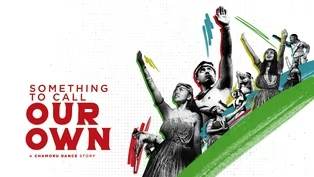
Something to Call Our Own - Trailer
Video has Closed Captions
A compelling look inside the origins, obstacles, and evolution of modern CHamoru dance. (1m 30s)
Providing Support for PBS.org
Learn Moreabout PBS online sponsorship









Support for PBS provided by:
Something to Call Our Own: A CHamoru Dance Story is a local public television program presented by PBS GUAM