
Taking Note — Keila Wakao
Special | 11m 55sVideo has Closed Captions
First taking up the violin at age three, Keila Wakao was raised in a musical family.
First taking up the violin at age three, Keila Wakao was raised in a musical family with her mother on the piano and her father on the oboe. A regular student at the New England Conservatory of Music, she now plays on a 1690 Stradivarius violin. She performs Clara Schumann’s Romance, Op. 22, No. 1 and Polonaise No. 1 in D Major by Henryk Wieniawski.
Problems playing video? | Closed Captioning Feedback
Problems playing video? | Closed Captioning Feedback
Major series funding for GREAT PERFORMANCES is provided by The Joseph & Robert Cornell Memorial Foundation, the Anna-Maria and Stephen Kellen Arts Fund, the LuEsther T. Mertz Charitable Trust, Sue...
Support provided by:

Taking Note — Keila Wakao
Special | 11m 55sVideo has Closed Captions
First taking up the violin at age three, Keila Wakao was raised in a musical family with her mother on the piano and her father on the oboe. A regular student at the New England Conservatory of Music, she now plays on a 1690 Stradivarius violin. She performs Clara Schumann’s Romance, Op. 22, No. 1 and Polonaise No. 1 in D Major by Henryk Wieniawski.
Problems playing video? | Closed Captioning Feedback
Where to Watch Great Performances
Great Performances is available to stream on pbs.org and the PBS app.
Buy Now
Great Performances Newsletter
Subscribe to the Great Performances newsletter to keep up with the latest full episodes to stream, exclusive content, and more!Providing Support for PBS.org
Learn Moreabout PBS online sponsorshipMore from This Collection
Taking Note is a new digital series spotlighting rising instrumentalists who have received Career Grant Awards from the Avery Fisher Artist Program. Each year, the program awards $25,000 to instrumentalists and chamber ensembles in support of professional music development.
Video has Closed Captions
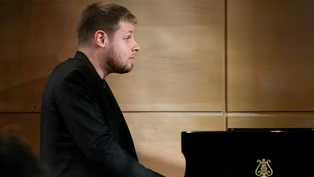
Pianist Dmitry Yudin immigrated from Moscow to the United States to follow his older sister. (10m 52s)
Video has Closed Captions
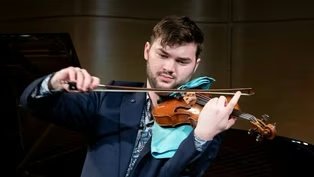
Nathan Meltzer first picked up the violin while living in Vienna and attending elementary school. (16m 16s)
Video has Closed Captions
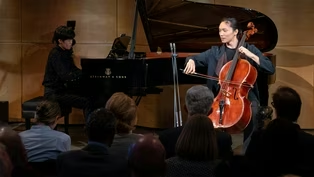
Cellist Leland Ko shares the impact his teachers have had on him on his musical journey. (14m 8s)
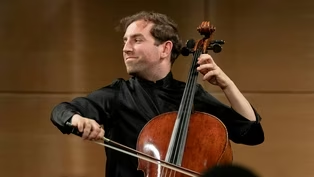
Video has Closed Captions
Cellist Tommy Mesa's love of music began with his interest in playing drums. (10m 44s)
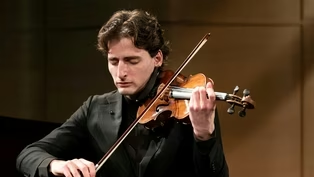
Video has Closed Captions
Following in his brother’s footsteps, Joshua Brown picked up the violin at age two. (9m 3s)
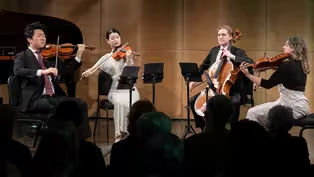
Video has Closed Captions
Composed of violinists Lucy Wang and Hao Zhou, violist Aiden Kane, and cellist Tate Zawadiuk. (11m 54s)
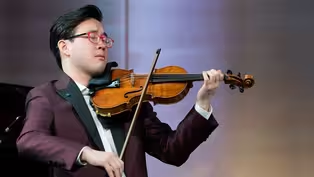
Video has Closed Captions
A profile of violinist Julian Rhee, winner of a 2024 Avery Fisher Career Grant Award. (10m 11s)

Taking Note - Balourdet Quartet
Video has Closed Captions
A profile of Balourdet Quartet, winner of a 2024 Avery Fisher Career Grant Award. (9m 18s)
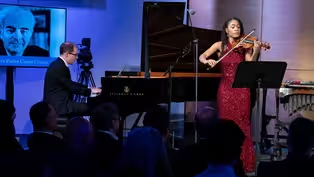
Taking Note - Njioma Chinyere Grevious
Video has Closed Captions
A profile of violinist Njioma Chinyere Grevious, winner of a 2024 Avery Fisher Career Grant Award. (8m 41s)
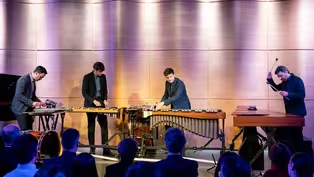
Taking Note - Sandbox Percussion
Video has Closed Captions
A profile of Sandbox Percussion, winner of a 2024 Avery Fisher Career Grant Award. (10m 4s)
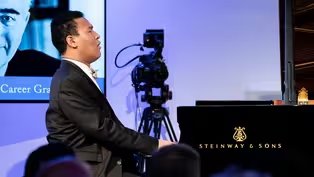
Taking Note - Clayton Stephenson
Video has Closed Captions
A profile of pianist Clayton Stephenson, winner of a 2024 Avery Fisher Career Grant Award. (9m 57s)
Providing Support for PBS.org
Learn Moreabout PBS online sponsorshipThe Stradivarius just took over, and it's been a wonderful experience ever since.
♪♪ I started playing the violin when I was three years old.
And I grew up in a very musical household, so constantly there was music either being played or on the radio growing up.
And naturally, violin became an instrument I started with because a lot of our family friends were also musicians, and their children would play violin or cello or piano, and violin spoke to me the most.
And so I began this instrument at three.
And growing up, my father played the oboe and my mom played the piano.
So I would always hear, my dad practicing the oboe, and my mom would be playing a bit on the piano.
So we would play together a lot.
Currently, I am a second year student at the New England Conservatory of Music, studying with Miriam Fried.
It's my second year studying with her.
But she is definitely a huge part of my life already.
And I grew up in Boston, so the New England Conservatory of Music I have been going to for the preparatory division since I was like nine years old.
So Boston and NEC is very much like home to me.
But I began with a new teacher two years ago, so it's been a wonderful time.
I currently play on a 1690 Antonio Stradivarius violin on generous loan from the Ueno Foundation through the Rare Violins of New York.
And this instrument is.... I mean, it's my dream instrument, really.
It's been almost two years since I first met this violin, and it has such a wonderful, warm quality to it.
And when I first played on it, immediately I could, understand not only the potential of this instrument, but also, that it's a very historic instrument played by many wonderful violinists in the past.
So seeing it up close and holding it was, I not only felt a big sense of responsibility, but, it's just surreal that I get to, you know, continue, performing on this violin after so many other distinguished musicians.
♪♪ But the thing about a Stradivarius is that many people think that the moment you put your hands on it, it's going to speak to you immediately.
Which actually, Stradivarius violins are quite complex in a way.
It took me several months for this instrument to really, be connected to me.
And, and so there was a lot of... I had to really, play a lot and discover, Oh if I put less pressure on the bow, then I would get a more, radiant sound, or I had to kind of, experiment a lot in order to really find the sound that spoke to me the most.
And once I did, the Stradivarius just took over, and it's been a wonderful experience ever since.
♪♪ Last night, out of the two pieces I performed, I performed Clara Schumann's first romance, which was composed in 1853, one year before the tragic suicide attempt of her husband.
Clara Schumann's compositions were greatly influenced by her talent as a pianist, as a performer, and she dedicated these romances to Joseph Joachim, who was a fantastic violinist, and she performed these works with him, which is, I can't imagine how beautiful that must have been.
But this first romance, it begins with a short introduction from the piano, and then the violin comes in, and the middle section there is, a high point, where for me, I believe it's like the the most heightened moment of expression.
Also, it is also the highest note in the romance, but there is, almost like a cry of, of so much emotion that Clara Schumann has.
And that part is also happens to be my favorite part of this romance.
And then it concludes with, a very reflective, reflective and, serene ending.
Even during the most, uplifting moments, there is always a tinge of some inner intensity or, or grief somewhere at present.
And in this first romance especially, there are moments where there is a uplifting quality to it.
But I really, try to bring out this inner, inner feeling of the music.
And this first romance is actually my favorite out of the three, which is also why I chose to perform it.
♪♪ The other work I performed was Wieniawskis Polonaise No.1 in D major, and this piece is absolutely so fun to perform.
It was composed in 1848 when he was only 13 years old, which is impressive to say the least.
And I actually learned this piece for the first time when I was 13, which is a funny coincidence, but Wieniawski, he is known for composing so many virtuosic showpieces, and this one in particular, has a lot of, of this Polish dance, this national, identity to it.
The piano has a very robust introduction.
And then the violin comes in with this, I mean, dance like character.
There is a lot of quite beautiful harmonies and, lyrical sections of this piece.
And when approaching this piece personally, I try to, engage more with the lyrical sides of this piece, which I think sometimes, is more overlooked because of this virtuosic character that is so present in the piece.
And so, in the middle section, when I really listen to the piano's harmonies, they're so beautiful.
And I, I truly try to really understand these harmonies and see how they reflect how I would play, these lyrical passages.
♪♪ Over the years, I've had a fantastic relationship with the Boston Symphony Orchestra and Tanglewood.
I'm very grateful for this relationship.
Back in September 2024, I performed at the BSOs opening night concert, opening night gala, and that was the beginning of my performance relationship with this wonderful orchestra and community.
And last summer I performed at Ozawa Hall for Seiji Ozawas sculpture unveiling ceremony.
And in the audience were members of the BSO, as well as members of Seiji Ozawas family and John Williams, which was crazy to think about, because I could see every single person in the audience.
So it was, I mean, I can't even explain in words how amazing it was to be able to play music for such a distinguished audience.
♪♪ And in July of this year, I'll be making my debut with the Boston Symphony Orchestra at the Tanglewood Music Festival, playing the Barber Violin Concerto, which I am so excited about.
♪♪
 New Episode
- Arts and Music

Innovative musicians from every genre perform live in the longest-running music series.

- Arts and Music
The Best of the Joy of Painting with Bob Ross
A pop icon, Bob Ross offers soothing words of wisdom as he paints captivating landscapes.






 New Episode
 New Episode
Support for PBS provided by:
Major series funding for GREAT PERFORMANCES is provided by The Joseph & Robert Cornell Memorial Foundation, the Anna-Maria and Stephen Kellen Arts Fund, the LuEsther T. Mertz Charitable Trust, Sue...