
Vintage First Finds, Hour 2
Season 30 Episode 17 | 52m 45sVideo has Closed Captions
Premiere vintage finds from ROADSHOW’s first season! Do values hold up in today’s market?
See premiere vintage finds from ROADSHOW’s first season including a Gibson style H-2 mandola, ca. 1918, a Tiffany Studios Daffodil lamp, ca. 1906, and an 1852 Lincoln manuscript! One illuminating find has a value jump to $50K-$70K!
Problems playing video? | Closed Captioning Feedback
Problems playing video? | Closed Captioning Feedback
Funding for ANTIQUES ROADSHOW is provided by American Cruise Lines and Ancestry. Additional funding is provided by public television viewers.
Support provided by:


Vintage First Finds, Hour 2
Season 30 Episode 17 | 52m 45sVideo has Closed Captions
See premiere vintage finds from ROADSHOW’s first season including a Gibson style H-2 mandola, ca. 1918, a Tiffany Studios Daffodil lamp, ca. 1906, and an 1852 Lincoln manuscript! One illuminating find has a value jump to $50K-$70K!
Problems playing video? | Closed Captioning Feedback
Where to Watch Antiques Roadshow
Antiques Roadshow is available to stream on pbs.org and the PBS app.
Buy Now

ANTIQUES ROADSHOW's 2026 Production Tour
Enter now for a chance to win a pair of free tickets to one of the three stops on ANTIQUES ROADSHOW's 2026 Tour. Sweepstakes entry deadline is April 6.Providing Support for PBS.org
Learn Moreabout PBS online sponsorship♪ ♪ APPRAISER: It's a nice looking American League ball.
GUEST: It is, it is.
And, uh, somebody signed it.
"Somebody?"
Somebody.
Pick it up, fill it with your liquor and... APPRAISER: Give it a good blow.
(blows) ♪ ♪ CORAL PEÑA: "Antiques Roadshow's" inaugural tour in 1996 attracted curious crowds seeking knowledge of their prized possessions.
What is it?
How much is it worth?
Is it real?
Those are still common "Roadshow" questions that appraisers, including some now familiar faces, first heard in stops across the Eastern Seaboard.
It's been 30 years since these East Coast guests laughed, cried or gasped when discovering the truth about their treasures.
Would they react differently to today's valuations?
See how times have changed in Hour Two of "Vintage First Finds."
APPRAISER: So, Stewart, did you pick this up at a Durham Bulls game?
No, I-I don't think so.
It's, um... there's a little story that goes behind it.
It's a nice looking American League ball.
It is, it is.
And, uh, somebody signed it.
"Somebody?"
Somebody.
Who might that be?
The Babe.
The Babe.
The Babe.
Ah... there's a mystery here.
Oh, yeah.
So you don't look old enough to have been around with the Babe.
(laughs) Well, thank you, I'll be sure to tell myself that.
The, um--- actually, the story behind it is we had some friends when we lived in D.C.
Mm-hm.
And Babe Ruth hit it over the stadium, over the stadium wall.
And after the game, he came over and signed it.
And... ...from there, the friends gave it to my mother, who gave it to me, and then I just gave it to my little son, Stewart Jr.
And it's sitting on the bureau under glass, and it's-it's pretty exciting.
That's great-- well, it's a lovely looking ball.
Um, I've seen a number of these balls before with this signature.
Now, you have to remember that there were a number of these balls produced.
The biggest problem in baseball balls today is that there are a lot of forged signatures.
Right.
You have to be very, very careful.
And forged signatures are worth really nothing.
So I've seen this signature.
It looks completely like an authentic signature.
It's a fabulous story.
My guess on this ball is it's probably worth somewhere in the realm of $1,000 to $2,000.
Oh, really?
Yes, it is, so I wouldn't... (chuckling) ...go playing catch in the backyard anytime soon with it.
I'll talk to my son about that.
So are you, uh, are you happy about that?
(chuckles) I'm happy, I thought it was possibly a few hundred dollars, but it's-it's-it's really pretty exciting, and obviously, uh, we love it.
And my boy's into baseball, so he's gonna hold onto it.
Where had you been keeping this before?
Under glass on the bureau.
And I guess it's going back there.
It's going back there very carefully.
(chuckles) And get an armed escort on the way out.
This is a fantastic collection of trade cards.
Can you give me some history to it?
Well, it belonged to my great-grandfather, and he grew up in Magdeburg, Germany, and from what I understand from family history, as a teenager he collected these, and it was kind of his hobby to put them in the scrapbooks.
It was a company that produced meat extracts.
It's a meat rendering company, it's fantastic.
Yeah, and I don't know how often they issued the cards, but he would collect them... Mm-hmm.
...and then put them in the scrapbooks in the series.
They're chromolithographic advertising cards, and they have a variety of imagery to 'em.
It's phenomenal.
I mean, what happened was this company, when they issued the cards, they came with the, the can of the meat extract, and what you have here are some of the more expensive trading cards from the time period.
Right here you have a, um, image showing an American Indian.
Here you have, um, an image of what they thought Zululand looked like.
Here, these are beautiful chromolithographs of children, cherubs and butterflies.
You go through this and it's just, it's phenomenal.
Have you read these at all?
Yeah, when I was a little girl, my grandmother used to bring them out and let me sit, and I'd just sit by the hour and just go through them, and look at the stories.
Really?
I mean, just going through it, just look at it.
Here you have, like, great writers-- now, I don't know if you have any idea of their value.
Have you ever done any research?
No idea.
No, n-- I tried to find out about the company, but so many of the old companies in Germany are gone because of, you know, the Depression, the war.
Mm-hmm.
So I have, have no idea whatsoever.
Well, I-I just got to tell you that chromolithograph advertising from this time period, they sell for anywhere from $10 a card on up, depending on the imagery.
If they sold for a minimum price of $10 a card, that's the minimum value they are.
Now, some of these cards could be worth as high as $100 to $200 a card.
What we'd have to do is go through the book card by card and do an inventory.
Now, something that's very important, if you ever decided you wanted to sell these, you would have to take them off the pages, because collectors want the back to be in perfect condition.
So you'd have to do something so the glue wouldn't remain.
But, I mean, this is just a marvelous, marvelous collection of-of-of trade cards.
This is a painting that I found at a flea market in Wilmington, Vermont.
APPRAISER: Mm-hmm.
Mm-hmm.
What caught my attention was that I saw the, the yellow, uh, painting where... Mm-hmm.
...the, the light was coming through, and I was very struck by the beauty of the painting.
Right, so you bought it just 'cause you liked it, do you have any idea who it might be by or anything?
Well, I was looking through a magazine... Mm-hmm.
...and something caught my eye.
A signature in another painting... Right.
and I called and I found out who that artist was.
Uh-huh.
Once I found out who the artist was, then I began researching who the painting might be.
And who do you think that-that artist might be?
Uh, Paul Gauguin.
Uh-huh, okay, a famous, uh, 19th century French painter, yeah.
Yes.
Talking the signature, that's a little bit of a stretch.
First of all, because it starts with a "C" rather than a "P..." Mm-hmm.
...and we can see that right there.
And also, um, and there is a "G," which is similar to his work.
But the rest of it is not completely, uh, convincing that it is by Gauguin.
But the most overwhelming piece of evidence is really the materials it's made out of.
Mm-hmm.
Gauguin was known to use very rough canvas.
It looks almost like burlap.
Um, this canvas is actually much newer than-than he could even paint it on-- this was probably, um, manufactured no earlier than maybe 1920.
The weave of the canvas is too fine.
You can see that down here.
Mm-hmm.
And the type of stretchers that are o-- it's on are much newer than, um, he could have painted on.
He died in 1903.
Mm-hmm.
This is in inches-- exactly nine by 12 inches, indicates that it's of English or American origin... Mm-hmm.
...which pretty much negates, um, it being French, which would have been a metric, um, measurement.
So I think what you have is something done by, um, an Englishman or American, um, in the south of France, uh, sometime in the early part of the century.
There is a similarity in the signature... Mm-hmm.
...but I think, unfortunately, it's not a, uh, a Gauguin.
Well, we know that people, uh, they do copy other people's signatures and that kind of stuff.
So we knew that that was a possibility, um.
Yeah.
Yeah.
Given the fact it's an atypical subject matter, the-the signature's not quite right, and these, the-the-the materials aren't there.
I think it doesn't have that much of a chance, unfortunately.
Mm-hmm.
I wish it-- or it were, for you, but it's not.
Well, at least now we know.
Yeah, actually, something like this probably would be worth maybe $100 to $200.
I married a Dutchman, so anytime he sees a Dutch antique, he's quite interested in it.
And of course, he recognized this immediately at an antique show.
So, uh, the purpose of the wedding cup is to pick it up, fill it with your liquor, and... (blows) APPRAISER: Give it a good blow.
Before it stops... (chuckles) ...turning, and of course, many grooms got very drunk if they were too excited to blow a lot.
So... (chuckles) so I understand you didn't blow your chance.
No.
But you had to finish your liquor by the time the windmill stopped.
That's correct.
Otherwise, you just kept doing it.
Mm-hmm.
Now, what I can tell you about this piece is on the side over here is the mark that tells us that it's made in Amsterdam.
There's another mark on it, that's on one of the windmill blades and that we were able to look up and see that was actually produced right down to 1893.
So we know it's a reproduction piece, extremely finely made.
Beautiful engraving.
A lot of fun to play with.
And value wise at auction, I would say would bring in the range of about $800 to $1,200 being such an attractive and fun item.
Oh.
(chuckles) That's wonderful.
(chuckles) This doll belonged to my mother, who died a little over a year ago.
She was 100 years old.
Oh, my goodness.
Yeah.
So, um, the doll is quite old.
Uh-huh.
Do you have a date for the doll?
I'm not sure whether it was Mama's, or whether it belonged to her aunt.
Um, yes, we can date the doll based on the style to be between 1850 and 1870.
Uh-huh, so that would have been her aunt's doll.
Right.
And, oh, a number of years ago I had her dressed... and we left... ...her old... ...slip... Right.
...and her little panties on.
So there-- Oh, that's wonderful.
There, the old part, unfortunately, she lost a leg... Right.
...somewhere along the way.
Well, it's interesting 'cause this doll is, um, a China-head doll.
Yes.
Um, it actually comes from Germany.
Based on the condition and the size and all, probably worth about $400.
Um, but it's nice that she's in the south and with you.
I have her on the bed in an upstairs bedroom.
(laughs) Oh, good!
So a vital spot.
So she's right at-- she's right at home.
Good, good.
Well, thank you very much for bringing her in today.
Well, thank you.
Now, Mr.
Williams, you've brought me, uh, what looks like a very interesting book here.
Um, you know the name of the author, I think?
I think it's, uh, Thomas H. McKenney, yes.
McKenney.
This is a very important record of American Indian life.
It's a very, uh, fine and well-known piece of Americana.
But I noticed that there's something unusual about this copy.
And I want you to tell me about this signature that we find.
It's very fragile.
Mm-hmm.
Now tell me about the signature here.
My grandfather gave me this book and his mother was Arry Ann Quinn and a Cherokee princess.
During the early 1900s, they were trying to get claims against the government for land and consequently, my grandfather was trying to trace the roots.
Yeah.
Um... During those days, there weren't a lot of papers available.
Right.
Um... (papers rustling) Just, um-- Now, tell me-- tell me about-- is this her signature, do you think?
I have no idea.
Yeah.
It certainly looks like it.
And her name was Eliza Jane... Jane Arry Ann Quinn.
...Quinn.
And then she's written, "Cherokee Sac Fox tribe."
Yes.
So that was the branch of the Indian tribes that she must have belonged to.
She must have, yes.
Yeah.
But-but you have some more material there.
Yes, I have a-- what I think is a picture of her.
And here's this.
And I also have her marriage certificate.
1853.
1853 in Philadelphia.
Yes.
Right.
And this is the copy of one of the claims.
So you have the whole story here.
Then this comes up to as late as 1907, and this is the Special Commissioner of the Court of Claims of the Eastern Cherokee Enrollment.
This has been sitting in my closet for quite a while.
Well, you have a wonderful piece of family memorabilia, which is also a wonderful piece of, uh, Americana and of Native American history.
This book is ordinarily worth, say, $8,000 to $10,000.
Unfortunately, the condition is pretty... Mm-hmm.
...rugged-- at present day values, I would put $5,000 to $6,000 on it.
Mm-hmm.
And it certainly has one of the most interesting stories that I've ever seen with any copy of this book.
It's really terrific.
GUEST: This has been handed down through my husband's family for the past nine generations.
And they traced it back to an ancestor named Benjamin Gale from Troy, New York, and Williamstown, Massachusetts.
This is a Boston high chest of drawers made about 1740 in a city that was the absolute center-- a style center, in fact, for the colonies in the mid-18th century.
And this piece would have been, uh, to Boston what the pyramid really was to Egypt.
In fact, all of the other colonies looked to Boston in the, in the mid-18th century for advice on fashion, and it was pieces such as this that would make Boston one of the leading centers for inlaid and, and-and also veneered furniture.
LESLIE: This fan carved center drawer is really symbolizing the sunburst.
Mm-hmm.
And also it's repeated on the lower section.
The-these drawers are very meticulously inlaid, just great quality, and very carefully laid out and graduated smaller as we get higher up the case.
So our eyes are led up the case and all of this upward movement is supported on these delicate cabriole legs which unfold into these pad feet.
Mm-hmm.
The piece has been cleaned, and, um, I'll-I'll show you a-a fascinating thing.
We found this today when-when we were looking through the drawers, along with some valentine cards that are in here from your family or your husband's family, which were kind of cute.
(chuckles) We forgot to take those out.
That's okay, I think they add to the interest of the, of the piece.
(chuckles) Yeah.
But this piece actually was in a drawer and it has the old grungy original finish.
And this piece actually fits right up, right up here.
It... right there, and it must have come off at some point, but the interesting thing, and the sad thing in a way, is that if the piece had a finish like this, it would probably be worth about $100,000 to $120,000, with this old crackled finish.
And in fact, they've cleaned it off, and even though it has the original brasses, they have taken the finish off.
Good brass.
Unless-- what would you say that it would be worth e... ...uh, as a clean piece?
Clean piece, about $50,000.
GUEST: $50,000.
LEIGH: About $50,000.
But it would have been $100,000... Would have been 100 and something.
So if you want to... (chuckles) ...try to make it grungy again, it might... Increase the value, make it grungy.
Right.
It was a painting that was given to my mother, uh, in the 1930s by a close friend of Robert Henri's.
Uh-huh.
And, um, I have inherited it.
Yeah.
Uh-huh, well, it's a lovely painting.
Uh, Robert Henri, as you may or may not know, was one of the founding members of the American Ashcan School.
Yes.
Uh, the issue with the valuation of this particular painting is, is interesting in that it's not the subject and the topic that he was primarily known for.
Right.
Right.
He did these wonderfully animated portraits... Mm-hmm.
...and New York scenes.
And this is much more subtle.
I see on the back that it's titled "Overland Road."
Yes.
Uh, does that have any meaning for your...?
No, none whatsoever.
Your family was from New York State or...?
No, from Connecticut, yes.
Uh-huh.
And it was, and it was a gift then?
Yeah.
Yes.
Well, it's a wonderful painting.
A little atypical for the artist, but by such an important artist, that I would put a value on it between $8,000 and $12,000.
Very good.
(chuckles) APPRAISER: At first glance, most people would, uh, probably think this is a mandolin.
But in fact, um, looking at it very quickly, I can tell by the size that it's not a mandolin, but a mandola.
Mm-hmm.
And, uh, kind of an odd duck in, in the development of American instruments, of course, also by the peghead up top, tells us it's made by the Gibson Company.
Right.
And if you look right inside, they always label them and put a serial number right in there.
"36, 76, 4."
And it's probably around, I'm going to say, 1917, 1918, thereabouts.
Mm-hmm.
What makes this interesting, an interesting development are, are a few things.
We know the mandolin as sort of a bowlback instrument.
Right, right.
Came from Italy.
Um, this, in fact, uh, was made, uh, the idea came from Orville Gibson... Right.
...fellow who was a maker in, um, in Kalamazoo, Michigan, of all places.
And this instrument, if you look at the shape of it, it has a little bit of arc to it.
Right.
And we're gonna flip it over and you can see it again.
And that is not pressed, as most people think, but it's actually carved, and that was his idea.
He made these as mandolins, mandolas, mandocellos, and mandolin basses.
It'd be a great instrument to play.
Um, uh, they're actually quite, uh, coming back into style a little bit, uh, with, uh, bluegrass bands... Mm-hmm.
...and actually, also, um, Irish bands.
If you were to go out today and, uh, and purchase this instrument new, probably $1,800 to $2,200, depending on where you're looking... Mm-hmm.
...and what sort of condition it was in.
Right.
Um, and, uh... and quite interesting.
What's nice about this, it's in great shape.
Right.
Usually, I see them and the, the binding is cracked... Mm-hmm.
...and, uh, um, the, the pick guard is missing.
This has its original pick guard.
I was going to ask about that too, because the pick guard itself is dated another date.
Exactly, it has a patent date on it.
And the patent date, uh, you can see right here is patent applied for March 3, 1900, it looks like, or 1909... Mm-hmm.
...but the serial number will give us exact dating.
Right.
So great piece.
And, um, my suggestion to you, take up the mandola, play it.
Great.
Okay, thank you.
My grandparents were married in 1912, and on their first anniversary, my grandfather offered her a piece of jewelry or anything else that she wanted.
And she saw this vase and she said, "This is what I want more than anything else."
It sat for a long number of years up next to my grandfather's humidor on the top of the bookcase.
So I knew it was something special.
This is a piece of carved cameo glass, and it's by a company named Daum.
Now, it's signed on the side, "Daum Nancy."
Mm-hmm.
And it also, if you notice, has the Cross of Lorraine here on the side.
Hm.
Now, this is just because of a city in France called Nancy-- I know that earlier that you thought it was carved by a person named Nancy Daum.
Daum, mm-hm.
Um, Daum Nancy had a long and rich history from the 19th century and into the 20th century.
What makes this a special piece of carved cameo glass is the incredible color of the glass here.
We call this an autumn vase.
And if you look as the light shines down through the top, you see the incredible colors here.
What's unusual is that there are five colors in this vase.
Now we categorize colored glass or art glass-- a lot of the... ... the value of glass is the strength of the color as well as the quality of the color and as well as the number of colors in it.
Can you tell me how they got the colors on this?
Well, actually the colors are in the glass and it was actually carved down to reveal different colors so that you see that it was all relief carving here.
Do you see how it's raised?
Mm-hmm, right.
Mm-hmm.
That means that they actually wheel-carved and got down to the clear areas.
And the glass was all different colors, kind of cased over the top, just a layer applied, and then they just carved it out and etched the design in relief.
Mm-hmm.
This is a five-color vase and we find that very unusual.
Now what we know about it is here on the underside it's marked "France."
Mm-hmm.
So we know that it's a piece of glass that was executed after 1892.
What I believe this is is a piece of Daum Nancy executed in the first quarter of the 20th century, which would coincide with your date of their marriage in 1912 and the gifting to her in 1913.
So I think they bought it brand new.
It's a really, really beautiful piece and there's not a chip on it.
Mm-hmm.
It's always been well cared for on the top of the shelf.
Um, do you have any idea as to what it's worth?
I have no idea.
I believe that you're going to find an auction estimated value on this at about $2,500 to $4,000.
Hm.
It's just a, it's just an outstanding example, and collectors are really going to love it.
Well, collectors love it, but somehow, when it's been in the family and my grandmother loved it so much, I would like to keep it in the family, where it's... My advice to you... Mm-hmm.
...is to write down the family history on it... Mm-hmm.
...and just put it on a little piece of paper and just tuck it on the inside so that future generations will always know where it came from.
Mm.
This was actually my something borrowed on my wedding day, um, and my mother-in-law very graciously loaned it to me.
Um, I was really hoping at the end of the, the wedding, that she'd turn to me and say, "Well, congratulations my dear, and here's, here's a gift for you," because I think it's a very lovely pin.
But in fact, she said, um, "That looks lovely on you.
May I please have it back?"
(chuckles) But five years later, on my wedding anniversary, she did give it to me as a present.
Well, it's a very exciting piece of what we call American Art Nouveau jewelry.
Mm-hmm.
It shows the profile-- classic profile of a woman and these beautiful flowers that are done in repoussé gold.
And what's interesting about this is that it's got, um, some writing on it.
I'm just going to look at it with my loupe.
And it says, "Autumn."
So it tells me that, um, there might have been a series made of the four seasons, and this is one.
And now I'm just going to examine the back of it.
Well, this is what we'd call the appraiser's dream.
It's a piece of jewelry that tells you who made it and almost the dating of it.
It's got a hallmark for a Newark, New Jersey company, Bippart, Griscom and Osborn.
And they started about 1886.
So this would date this to about 1890, turn of the century, and they did beautiful gold work; as you can see the chasing on it and the high relief.
Um, I think it's a great piece of jewelry.
It's in great condition.
It tells a story, it tells where it was made, the caratage.
Um, you have a winner.
I would say in the market today, you're probably looking at $1,000 to $1,500 for this small pin.
Wow, great.
It's a great piece of jewelry.
You have any questions about it?
Uh, not really-- say Newark, New Jersey was where it was manufactured?
Yeah, yeah, and they were actually one of the prime areas for jewelry manufacturing in this country.
And a lot of the gold work that we see from that period is absolutely beautiful.
This actually was used also for a watch holder, it has a, a stem in the back that you can actually attach a watch.
I was wondering what that stem was for, great.
Thank you.
Yeah.
So it's very, very exciting to see a great piece of American Art Nouveau jewelry.
We purchased it in Pennsylvania, although it was sold to us as a New England hutch or corner cupboard.
APPRAISER: A-ha, so, you suspect that, uh, perhaps it might be from New England then?
I would think so-- I don't think it's, you know, uh, uh, it'd be nice if it was from the Hudson Valley, 'cause that stuff is nice, too.
Well, I'll tell you what, Alice, it's, uh, it is from New England, but it's probably up a little bit further than you suspect, because the aspect of this piece, with its scrolled sides and coved applied moldings in these panel doors, is very distinctive of furniture that was actually made in Canada.
Canada?
Canada.
So the dealer you bought it from, uh, did he tell you it was a very valuable piece?
No, there was no indication of that.
Of course, you have to realize I've had the piece 40, 45 years.
Right.
And the attitude towards antiques is a lot different today than it was at that time.
Well, what do you think the value of the piece is?
Well, it'd be nice if I could get a nice new car out of it.
(both laughing) Well, if it's a new car, uh, I think it's going to be a very small car.
Small car.
And I would say its value is probably in the $2,500 to $3,500 range.
All right, I'm happy with that.
Well, it's charming-- well, thank you for bringing it in.
Yeah.
Yeah.
And, uh, it's a good place to put your China and your, uh... It holds a tremendous amount.
...storage.
APPRAISER: It's called a retablo.
This depiction is Our Lady of San Juan.
It was created by, basically, an itinerant artist in the early 1800s.
And this particular artist is well-known for his, his dot decoration.
He was actually referred to as the Dot and Dash Santero.
These were used in family homes because villages were scarce and churches were even scarcer.
So as a result, sometimes you even see devotional candle burns, and this might be evidence of that on the front, where they had candles lit at their family altars, they would appeal to certain saints that would have their, their particular favorites.
They changed this particular painter's name to the Arroyo Hondo Painter because, um, one of his largest works is found in a chapel in Arroyo Hondo, which is about ten miles north of Taos, New Mexico.
And it's, really, it's in great condition.
It hasn't been scrubbed over, it hasn't lost any of its gesso.
And similar works like this tend to sell between $3,500 and $4,500, boards of this size.
So it's a... it was a wonderful gift, and she's, she's very soulful and very beautiful.
Thank you.
You're welcome.
GUEST: I was working at the Pentagon, I'm working in the mail... APPRAISER: Yeah.
Working in the mailroom.
Then the president got killed.
And it come as a shock, you know.
Right.
And everybody said, "Oh, my goodness."
All this mail was coming in after the funeral and everything.
Exactly.
Ah... The... it was so in flux that they couldn't take it at the p-- regular post office, so they set up a mail's place at the Pentagon.
And you had to oversee that to make sure that... And me and two other supervisors were detailed over there as we process it, and then they would-- we would bag it up, and then they would send it back t-- over to the White House, and then they would take... Right.
...their mail room took care... ...of it from there.
... out-- from there, yeah, right.
Did you ever meet Jacqueline Kennedy?
Yes, I did.
Yeah?
And I met the president, too, also.
As well.
Right, right, yeah.
Wow.
I met the president also.
Okay, well-- well, let's start with this big piece here.
Mm.
Mm-hmm.
Tell me a little bit about this card and what's special about it.
She sent this along with the letter... Mm-hmm.
...and the picture of the family and this picture of The Green Room.
Right.
And it came around close to Christmas time, and she put a notation on... Her notation.
...the "Happy Christmas" and I was glad to get it, you know, as we weren't expecting, you know, no personal letter... Anything from... Okay, well, let me tell you a little bit about this.
Um, the photograph itself-- now, you can see the photo here.
Yeah.
There is some damage to the photograph.
Yes.
And let's just... Let's take a look at that, a closer look.
Yeah.
You see that there's a line through there.
Now, you can get that restored.
Yes.
There are photo processes now that you can get it restored.
Uh-huh.
Which I would suggest doing, because you've got the crease that goes right through... Yeah.
Yeah.
Yeah, yeah.
...the vast section of the photograph.
Yeah, because we've took it out-- it really-- we took it out, and it was just folded up.
She put it in the buffet, you know... Right, exactly.
...and so that's what happened.
Yeah, right.
The value here is, if you take a look at the letter, and if we get a close up here of the signature... Uh-huh.
This is a regular signature.
It's not a pen machine signature.
Right, right.
She actually signed this.
Right, right.
And also that the letter does reference-- if you read a little bit here, it does reference the president's death, and the sorrow, and thanking you for... Right.
Did you write her a letter or something?
No, I... But just for your service in sorting the letters.
Yes, sir, this is just for our services, yeah, right.
Right.
And it is on her personal stationery-- Mrs.
JFK.
Mm-hmm, right.
And this is a piece-- um, do you have any idea what the piece might be worth, or has anyone told you what it was worth?
No?
No.
No, no, no.
No.
This is a great package, all of the things together.
Uh-huh.
Even... not getting the, the photograph restored... Right.
Right.
Right.
...probably would still... Mm-hmm.
...enhance the value, because you have everything as one package.
Right, right, right.
Uh-huh.
Um, I would say this is a piece that a collector would probably spend at least $10,000 for.
Right, right, okay.
Is that something you were-- were you thinking about or hoping for, right?
(laughing): Yes, sir, making some money.
(laughing): Yeah, right, right.
Well, good.
APPRAISER: Is this something that descended in your family, or... GUEST: Not necessarily.
Uh, if you could really look close here, there's still some fold marks where this was just folded in between some linens... Right.
...inside of a trunk.
And you found it?
And I purchased the trunk of linens, and inside that trunk, I found... Boy, did you make a lucky find.
(chuckles) I would think so.
Yeah.
I mean, this is, uh, as you can see, a New England family register or record... Yes, it is.
that was wrought by Loisa Newhall.
Mm-hmm.
And part of the reason why these things are so valuable and so sought after by collectors is that they're not only beautiful, but you have incredible historical information that is right at your, at your fingertips.
Yes.
Which you know, because you've done all of this research.
Oh, there's so much available.
It's, it's incredible.
Really.
These are direct descendants of Thomas Newhall, the first settler of Lynn.
They also were associated with Paul Revere in Penobscot Bay.
The battles... This, this particular family?
This particular family.
Incredible.
And it is, as you can see from just looking at it, a remarkably beautiful piece... Right.
...as well as a, an historic piece.
These things were made in academies for the instruction of young women.
And this probably was the building of the Lynn Academy.
And then it has this wonderful floral border on it... Yes.
...where the silks have really maintained their color.
And even the linen, which tends to discolor over time... That's right.
...is really in very good shape.
It has no holes or tears or fabric loss.
Nothing whatsoever, no.
So it's really beautiful, and it's historical, and it's worth a considerable amount of money.
I mean, in terms of an auction estimate, we would probably estimate it somewhere in the vicinity of $20,000, and-and maybe more.
I see.
I-- very good.
One always hesitates to use the word "unique" when describing something, but, uh, I must say, I've never seen anything like it.
I understand it was made by a member of your family.
It would have been my husband, who's died, it would've been his grandfather.
So, he made this miniature teapot?
Mm-hmm.
About when?
It would've been about the turn of the, of the 20th century.
Now, what, what is the significance of this half dime?
The whole entire piece was made just from that dime.
There was nothing extra added to it.
Oh, I see.
So, this teapot was made out of a, a half dime like this?
Correct.
If we look underneath, you can even see part of the design of the half dime.
This was a, a popular coin.
Of course, nowadays, we think of them as nickels.
In the 19th century, these silver half dimes, um, were made, uh, in quite large quantities.
This one dates from the 1860s.
Um, I think this teapot actually works, doesn't it?
That's what made... The top comes off.
That's what made it so unique for the contest.
It actually pours.
Mm-hmm.
It pours, and the handle swivels.
Amazing.
Well, a marvelous piece of family history.
It's difficult to put a fixed price on it.
It's not the kind of thing that comes in every day.
This is difficult to find a price comparison.
My gut feeling, though, is that if it were to come up at auction with that fascinating history of silversmithing, it probably would sell for somewhere in the region of between $500 and $1,000.
Mm-hmm.
This is a pair of sculptures that we've had in the Athenaeum, um, since the early '40s.
They were given to us by Anna Hyatt Huntington.
And interestingly enough, they were sitting on an open bookshelf in a room that the public uses, and a patron came in one day and said, "Do you have any idea of what these are?"
And I did a little research and, and found out a little bit about her.
Mm-hmm.
Anna Hyatt Huntington was a leading American sculptor of the, uh, 20th century.
She was primarily known as an animal sculptor, although she did a number of monuments.
Uh, this is a very, very nice pair of bronze sculptures.
Uh, they were cast by the Gorham Foundry.
Uh, Gorham, uh, is the silver company that's very well-known in Providence, Rhode Island.
They did very, very fine castings.
These are done in the lost-wax process, which gives them a wonderful amount of detail.
And the patination is very, very good on these.
They're signed with her name, and it also has the foundry mark.
They're wonderful pieces.
As I said, most of her work, uh, is, uh, animal sculptures, so these are particularly rare because of the figures.
They would be worth in the neighborhood of $5,000 to $7,000 at auction.
Oh, that's exciting.
Yeah.
It's interesting, 'cause the... I think most libraries in New England have pieces like this, and we have no idea what we have.
Y-yeah, that's wonderful.
It's, it's kind of fun to find out what, what we really do have.
Good, I'm glad you came in.
So, thank you.
(indistinct chatter) APPRAISER: Well, this is a very lovely etching.
It's an original etching on chine appliqué by Marc Chagall.
Um, you can see, it's originally signed in pencil here, and it's numbered 20 out of 40, which is quite a small edition size for Chagall.
Uh, this particular piece was published by Gérald Cramer.
It's from a portfolio of original prints.
And this piece was taken out and framed.
Uh, it's an original etching printed on chine appliqué, which is a tissue-thin paper which is applied to a stronger wove support.
Uh, it's very, very nice.
This frame looks like it might not be archival, so you might want to consider having it reframed.
In other words, acid-free?
Right, exactly.
Go to a frame shop and just say that you would like something framed archivally, and make sure the mat and the support are acid-free.
Otherwise you will see that the paper will start to stain.
It will start to stain... And it will turn very brown.
I, I wondered about it.
Yeah.
And that will have a big effect on the value.
Uh, condition is very important for prints, and yours looks to be in excellent condition, so that's good.
Also, make sure you hang it out of direct sunlight, because... It-- it never has been.
Oh, good.
Because the sun will also stain the paper.
And I had acquired it after he died.
Oh, you did?
So it was late '86 that I got it.
You did?
And where did you get it?
My daughter, uh, gave it to me.
She had gotten it in California.
Oh, she did?
From an art gallery.
Oh, really?
I don't know what the circumstances were.
Uh-huh, but she gave it to you as a gift?
She gave it to me.
Yes.
Well, it's very lovely, and I think if it's something-- let's see, at auction it would probably bring around $2,000 to $3,000.
Really?
Mm-hmm.
(laughs) It was worth the trip down.
Good, I'm glad to hear it.
(chuckles) Really?
Mm-hmm.
(laughing): I'm very surprised.
(chuckles) Did you think it was worth a lot less?
Much less.
Oh, well, good.
Much less.
(laughs) Well, the market for Chagall right now is very strong.
Well, because he died, I suppose.
Well, he's also a very important 20th century artist.
And he is.
Yeah, so.
It's quite lovely.
I'm absolutely shocked.
(both laugh) Laura.
Well, I like to go to porch sales and house sales and things like that, and I found it last year at a house sale.
Are you familiar with what it is?
Any ideas, or, uh... I'm, I'm not exactly sure what it is.
I think it's a book discussing what RKO Radio Pictures is going to produce for the coming year.
That's it.
They, uh... They're very nice books.
They were really sent out just to the primary theaters across the country.
Often, less than 1,000 are made of each one.
Mm-hmm.
And usually, they're-- they're kind of in the $200 range for the most part.
A little more if they have a lot of color in them.
Uh, but they have great pages.
There's a nice beautiful Disney page, and they did westerns.
A lot of famous stars, usually, if it was a big studio.
But the thing that really is nice about this book is... this particular page here, with Orson Welles.
Oh, yes.
And I'm sure you noticed that the title is "John Citizen, U.S.A."
So, what do we think that turned into?
I-I think that became "Citizen Kane," am I right?
That's it, yep.
The following year, it became really one of the world's greatest movies.
Considered, uh, you know, an all-time classic by a lot of film critics.
Mm-hmm.
I personally have sold this book for about $750, but that goes back about three years, so... Wow.
I'm putting this one at around $1,000 for now.
I'm impressed.
Really, a nice piece.
And you got w-- wonderful condition here.
It's really nice.
Mm-hmm.
I assumed it was somewhat collectible, but I, I just thought it was very attractive.
Of course, they don't make movies like this anymore.
GUEST: This actually belonged to my father.
He was a teacher of science in an English county grammar school.
APPRAISER: I see.
And apparently, when he first started, after the First World War, being the youngest, he got the jobs nobody else wanted.
Uh-huh.
And so he was in charge of the lost property, and this little globe was actually in the lost property.
And so at the end of the year, he didn't want to throw it away, so he took it home, and it's lived with us ever since.
And he treasured it and passed it on to you... Oh, yes.
Mm.
...and you've kept it all these years?
Yes.
Just take it out so we can see that... what we have here is a, uh... a little terrestrial globe, showing the various continents and oceans.
And on the inside of the case... is a, uh, celestial map, showing the heavens.
Now, the case appears to be shark skin, sometimes also called shagreen.
And it's a, uh, it's a hard surface that can be stretched around a shape like this.
And we can see here that it says, "A terrestrial globe, G. Adams, number 60 Fleet Street, London."
So we know where it was made.
And we can see a map of Australia here, and it says "New Holland."
Mm-hmm.
These are quite collectible these days.
There are people who collect just maps and globes.
And because it's a small, attractive object, it's, it's quite a nice thing to collect.
I would estimate this to be worth... um, between $2,500 and $3,500.
Really?
Hm.
Wow.
APPRAISER: What you have is a Lincoln manuscript, and I'd love for you to tell me a little bit about what you know about the document.
Well, my great grandfather, uh, O.L.
Davis, practiced law with Abraham Lincoln from 1842 to 1849.
Mm-hmm.
And this document, which is the only one that has survived, has been passed down through my family, is a contingent fee contract, signed-- uh, written by Lincoln, and signed by the client.
Mm-hmm.
And Carl Sandburg, in his "Prairie Years," said that Lincoln was so ethical, that he never took a fee on a contingent basis.
Well, I hate to tell Mr.
Sandburg, who's now deceased, that he was wrong.
Mm-hmm.
And it's a document that I've had a lot of fun showing people and... Well, it-it certainly is a lovely document.
It's dated from May 15, 1852.
It has an integral signature, that means that Abraham Lincoln's name is within the text.
He wrote his name within the text... Mm-hmm.
...and someone else signed off on it.
Um, it looks as if it's been well-repaired.
I gather that your grandfather must have shown it around quite a bit... (laughing): Yeah.
...because, um, as we look on the back here, there seems to be tape repairs on the back of the document.
There seems to be also some repair work, almost what we would call some silking, which is, um, a repair technique on the front.
Um, Lincoln material has been doing extremely well at auction, and an early piece from his law years would make it a very, very special piece.
Um, my... do you have any ideas as to the value of an item like this?
(chuckling): I... I have no idea.
Well, I would say that something like this would probably be in the price range of $8,000 to $10,000.
Oh, well, good.
Um, because it is completely in his handwriting.
Mostly we will see documents by Lincoln that are just signed by him, but being that this actually is fully in his hand, gives it a good, sturdy estimate at auction.
Oh, good.
And I think that it would do extremely well.
So you've got a nice little piece here.
Yeah, well, I'll never sell it.
Take it off the shelf and not keep it in my closet.
That's right.
But don't put it in too much sunlight because that will only damage it a bit more.
No, I won't.
I've been trying for a long time to find out just what I did have here.
They came from an estate of a friend... Mm-hmm.
...and she'd had them for many years.
There was a third one that's missing.
Now, you pointed out to me that... this one, you had found had a little mark on the bottom that said Spode, for the English Spode Company.
So did you have any idea of how early this might be?
Had no idea.
But I did recall that she had told me that it was never illustrated in a Spode book, so that she didn't know anything about it, um... and that's all I knew.
Well, these are really very interesting, because this one is a Chinese blue and white cup with this little figure on the inside, and it was probably made between, I would say, 1790 and 1815 to '20.
They're really more or less of a tourist item, something that, that somebody'd put on a mantle.
And what's curious is that this one, by Spode in England, is a copy of yours.
So, if you-- would you pick this one up, so we could see?
See-- you see how similar the design is?
Here's the outline of the flower and the flower here.
And on the back, we have the same two little birds.
And the figure in the Spode one has been painted, whereas the one in the Chinese is left white.
And it's very rare to find a pair of these that might be together.
I've always been interested in this type of what I call "chicken or the egg."
Did Spode make this from another one first and then the Chinese copy it, or did the Chinese one get here through the China trade and then Spode make it up?
I think in this case, since we know of these in the earlier 18th century, that this one is indeed the copy.
Is it significant?
I-- to my mind, the Spode looks like a very much finer-- well, it's obviously more detailed... Yes.
But a finer piece.
Well, the modeling in the figure of the Spode piece is certainly far superior to yours with the, uh, in the Chinese cup.
But I, I must say that as a collector myself of copies of Chinese and English ceramics, I think these are a very, very unusual pair, and I'm very glad you brought them in.
Oh, thank you.
I would say they had a value of-- as a pair-- of between $800 and, uh, $1,000.
Oh, wow.
(both laugh) Are you surprised?
Very surprised.
(laughing): Because if I'd bought... I would probably not pay $60 for either one of them.
(both laugh) Well... If I see another, however... If you see another... I'll buy it for you.
...add it right over here, okay?
Thank you again.
GUEST: Well, my father bought them for me when, sometime in the 1950s, uh, for my sister and myself.
And we played with them for a while, and then, like many toys, they were put in the bag and thrown in the closet.
We're talking about some puppets that date, um... I guess, when your father bought 'em, they were already, you know, about 25 or 30 years old.
Fairly.
Yeah, they were fairly old.
If anybody told me I was gonna have-- be appraising or looking at some WPA puppets here at the "Roadshow," I would have said, "no way."
(laughs) The WPA was a, a make-work kind of thing.
Mm-hmm.
Starving artists and people who couldn't find a job were, were hired.
They, they would create these puppets and would go and give shows for children.
Oh.
But I ne-- as I say, I've never seen the quality.
Especially when you, you have these wonderful little... the three pigs with this incredible wolf puppet.
Not only are they hand puppets, but they also are string-activated on the back so that their legs actually can work, too.
Mm-hmm.
I mean, it's, it's just amazing.
They're one-of-a-kind.
They're papier-mâché, handmade, it's-- in a certain way, it's very, very hard to evaluate something like this.
Mm, I can imagine.
If they were made by a, a, a famous puppeteer like Bunin or Baird, or something like that, we'd have some track record on them.
Mm-hmm.
Well, then I know there's a couple of other puppets... Mm-hmm.
...that go with the set and a few props as-- even as I know there's a hod of bricks for the brick layer... Right, and sticks... and, um, everything.
Everything you need to put on a radio... To put on a show.
Yes.
Which my sister and I did periodically.
We'd get the neighbors to come in and be subjected to our amateur puppetry.
But it was fun.
Oh, that's just, it's wonderful.
As far as value, in an auction, I would expect them to bring in the range of, uh, somewhere about $1,800 to $2,500 for the entire set.
And I think someone would be very happy to have them for that.
Oh, I think that'd be lovely.
And I'm sure my father paid nothing... near that.
Oh, I think so.
Probably-- I don't know what, I'll have to ask him afterwards.
Probably $50.
Yes, maybe.
If lucky.
If lucky.
If-- and at that time, that was a lot of money.
Mm-hmm, it was.
GUEST: My father was an attorney, and it was given to him in lieu of payment from a client.
APPRAISER: Fantastic.
And it stayed on his desk for many, many years.
And when he passed away, my mother passed it down to us.
Well, that's a great story.
Well, as you probably already know, it is in fact a Tiffany lamp, made in this country by Louis Comfort Tiffany sometime between 1899 and around 1910.
Tiffany was the son of Charles Tiffany, who started the, the um... uh, silversmiths in New York.
And had very-- they had little interaction until after his father's death where he took over some of the work at Tiffany & Co.
This is a signed lamp.
There are very few lamps that have integral bases and shades.
This is a-- called a "Four Virtues" base, and it's a highly desirable Tiffany base.
This is called the daffodil pattern.
All the Tiffany daffodil lamps in this pattern, in this style, are identical.
Same amount of pieces of glass, same lead lines.
The only thing that makes different-- one better than the other-- is the quality of glass.
And the selector of the glass was very important in the manufacture of this lamp.
This happens to be a great selection of, of glass.
You've got many different types of, of glass in here.
You've got mottled glass, which makes it look like different colors in one tile.
Mottling here, mottling here.
You've got striated glass, where you have the green just coming down in a line.
It's a-- it's a splendid example.
I would think, at auction, we would estimate this at somewhere between $25,000 and $40,000.
It's a great, great lamp.
PEÑA: You're watching "Antiques Roadshow: Vintage First Finds."
Enjoy "Roadshow" wherever you are.
Stream full episodes, follow @RoadshowPBS on social, and sign up for our newsletter at pbs.org/antiques.
More vintage "Roadshow" right after this.
♪ ♪ (indistinct chatter) (wires shifting) (clattering) ♪ ♪ MAN: There we go.
♪ ♪ I don't think so.
♪ ♪ (grunts) PEÑA: Thanks for watching.
See you next time on "Antiques Roadshow."
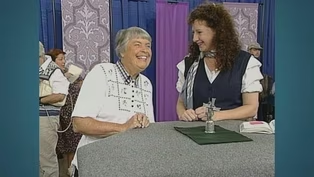 New
NewPreview: Vintage First Finds, Hour 2
Video has Closed Captions
Preview: S30 Ep17 | 30s | Premiere vintage finds from ROADSHOW’s first season! Do values hold up in today’s market? (30s)
Providing Support for PBS.org
Learn Moreabout PBS online sponsorship
- Home and How To

Hit the road in a classic car for a tour through Great Britain with two antiques experts.
 New Episode







 New Episode
 New Episode


Support for PBS provided by:
Funding for ANTIQUES ROADSHOW is provided by American Cruise Lines and Ancestry. Additional funding is provided by public television viewers.